

Tuesday, May 12, 2020
Wednesday, May 6, 2020
MICHAEL MCCLURE , RIP

THERE ARE HILLS LIKE SHARKFINS-- Michael McClure,
and clods of mud.
The mind drifts through
in the shape of a museum,
in the guise of a museum
dreaming dead friends:
Jim, Tom, Emmet, Bill.
—Like billboards their huge faces droop
and stretch on the walls,
on the walls of the cliffs out there,
where trees with white trunks
makes plumes on rock ridges.
My mind is fingers holding a pen.
Trees with white trunks
make plumes on rock ridges.
Rivers of sand are memories.
Memories make movies
on the dust of the desert.
Hawks with pale bellies
perch on the cactus,
their bodies are portholes
to other dimensions.
This might go on forever.
I am a snake and a tiptoe feather
at opposite ends of the scales
as they balance themselves
against each other.
This might go on forever.
"Mexico Seen from the Moving Car"
from Of Indigo and Saffron: New and Selected Poems.
Copyright © 2011 by Michael McClure. Reprinted by permission of University of California Press.Copyright © 2011 by Michael McClure. Reprinted by permission of University of California Press.
Of course I plan to write something longer and more concrete in a few days, but this note is say thank you to a great poet, a grand man, for a measure of fellowship and credible consul.
Monday, May 4, 2020
two poets, two poems
Called into Play
A.R. Ammons
Fall fell: so that's it for the leaf poetry:
some flurries have whitened the edges of roads
and lawns: time for that, the snow stuff: &
turkeys and old St. Nick: where am I going to
find something to write about I haven't already
written away: I will have to stop short, look
down, look up, look close, think, think, think:
but in what range should I think: should I
figure colors and outlines, given forms, say
mailboxes, or should I try to plumb what is
behind what and what behind that, deep down
where the surface has lost its semblance: or
should I think personally, such as this week
seems to have been crafted in hell: what: is
something going on: something besides this
diddledeediddle everyday matter-of-fact: I
could draw up an ancient memory that would
wipe this whole presence away: or I could fill
out my dreams with high syntheses turned into
concrete visionary forms: Lucre could lust
for Luster: bad angels could roar out of perdition
and kill the AIDS vaccine not quite
perfected yet: the gods could get down on
each other; the big gods could fly in from
nebulae unknown: but I'm only me: I have 4
interests--money, poetry, sex, death: I guess
I can jostle those. . . .

Since I've raged and ranted more than once around here about how there should be no more poems about poetry, I thought why I liked "Called into Play" and not the work of other writers. Attitude is the difference, I guess. My basic gripe is against those who regard poetry as a vehicle of relentless self-revelation, the sub-Nerudians and faux Rilkeans who seemed to have skipped the other qualities their inspiring source's poetry had and instead are determined to make a cult from the practice; the poet- as -priest is not an image that appeals to me and even the most supreme of egoist geniuses, Walt Whitman, would likely find the conceit a bit vain. I don't include the Language Poets, as someone had asked me, even though the poetic language is at the forefront of their work; the effort there, I think, is an honest and exciting investigation into new ways of thinking about how language can be written to more creatively engage the complexity of experience. Ammons, of course, is much less formal and has the aura of someone just risen from bed and is trying to get the sleep from his eyes. What he sees is the same old things, only completely different, to paraphrase comedian Steve Wright.
Ammons demystifies the subject by simply talking about the search for something to write about. Often it's the case that he doesn't latch on to a topic to use his techniques upon, but with much subtly manipulated writing that at first seems plain and idiomatic, his writing turns into inquiries about being in the world with the senses absorbing the raw and restless data and creating a modicum of coherence within frameworks. Whether the room he's in, a conversation he's having, a recollection that becomes overwhelming if temporary obsession, Ammons writes a poetry that never relinquishes its commitment to the material world and the struggle to remain sane and resilient within its demands. This a metaphysics that William Carlos Williams would have appreciated, the idea that the thing itself is its own adequate symbol What he mentions here, things like lawns, mail, current events, are brought up as things he might impress into the details and subject of a poem he wants to write. He might have been talking about a mad search for missing car keys; there's humanity in this momentary frustration. There's the suggestion that Ammons is tired of his old turns of phrase and wants to forge new ones:
Ammons admits his limits as a seer or oracle and speaks of language as something he works with through the craft of poetry, a practice he works at diligently to find an expression that transcends mere competence and achieves an artfulness. The poem is funny and moving in its way, as Ammons' work is constantly aware of death, which makes philosophical certainty a cluster of moot points. This all puts A.R.Ammons' musings on poetry in sharp contrast to a host of others who'll essay forth in verse about poets being the intermediaries of Truths and Principles only a select few can design and decipher for the less gifted. Without repeating my previous misgivings, I'll say that this is his Hogwash and Elitism, and these are the sorts of people I imagine Ammons himself asking to go away.
DOO-WOP
Marvin Bell
He believes the tar pits hold bones but preserve
No emotions, and he believes space is matter.
He still thinks a kiss with full lips transformative,
the hope of a country boy with an uncultivated
heart, from the era of doo-wop and secret sex,
when the music was corny, cliched, and desperate
Like teenage love. Who now will admit that poetry
got its start there, in the loneliness that made love
From a song on red wax, from falsetto nonsense.
Who does not know that time passing passes on
Sadness? A splinter of a song lyric triggers shards.
Of memory and knots in his gut. He regrets he was
Lashed to the mast when the sirens called. He
believes the sea is not what sank or what washes
Up. There are nights the moon scares him.
Associative leaps are not the easiest thing to do when so much of what your attempting to get across has more to do with a transitional state of mind than it does a position that can be easily parsed and contained. Marvin Bell is one of those poets who can offer a string of nonsequiturs and still having you following the heart under the odd contrasts in his lines. Unlike Tony Hoagland's poem, "The Story of the Father" (featured at Slate last week), where what should have been seen from a longer prose narrative got compressed beyond human caring with mannered, showy language, Bell has the ease of line transition, the ability to jump from one nervy island of reference to another and provide a sense of something gathering speed, assuming nuance. The young man going forth into the world of the senses, sparked by music, sirens, scents, and touch; there is a skillfully maintained idea, implied and not editorialized as intruding and ineffective aside, of music as that thing that bypasses the mind's censors and entrenched protections against foolishness and lands and seeds the desire to experience more with the senses, to test one's expectations against experienced fact.
He believes the tar pits hold bones but preserve
No emotions, and he believes space is matter.
He still thinks a kiss with full lips transformative,
the hope of a country boy with an uncultivated
heart, from the era of doo-wop and secret sex,
when the music was corny, cliched, and desperate
Like teenage love.
This is a fast run of language, streaming, quite literally, with all the elements that compose it melded together in a fluidity that rushes towards a crashing and overwhelming satisfaction. Tempo, rhythm, what the hip-hoppers refer to as “flow,” this poem is simply perfect, simply lovely.
A.R. Ammons
Fall fell: so that's it for the leaf poetry:
some flurries have whitened the edges of roads
and lawns: time for that, the snow stuff: &
turkeys and old St. Nick: where am I going to
find something to write about I haven't already
written away: I will have to stop short, look
down, look up, look close, think, think, think:
but in what range should I think: should I
figure colors and outlines, given forms, say
mailboxes, or should I try to plumb what is
behind what and what behind that, deep down
where the surface has lost its semblance: or
should I think personally, such as this week
seems to have been crafted in hell: what: is
something going on: something besides this
diddledeediddle everyday matter-of-fact: I
could draw up an ancient memory that would
wipe this whole presence away: or I could fill
out my dreams with high syntheses turned into
concrete visionary forms: Lucre could lust
for Luster: bad angels could roar out of perdition
and kill the AIDS vaccine not quite
perfected yet: the gods could get down on
each other; the big gods could fly in from
nebulae unknown: but I'm only me: I have 4
interests--money, poetry, sex, death: I guess
I can jostle those. . . .

Since I've raged and ranted more than once around here about how there should be no more poems about poetry, I thought why I liked "Called into Play" and not the work of other writers. Attitude is the difference, I guess. My basic gripe is against those who regard poetry as a vehicle of relentless self-revelation, the sub-Nerudians and faux Rilkeans who seemed to have skipped the other qualities their inspiring source's poetry had and instead are determined to make a cult from the practice; the poet- as -priest is not an image that appeals to me and even the most supreme of egoist geniuses, Walt Whitman, would likely find the conceit a bit vain. I don't include the Language Poets, as someone had asked me, even though the poetic language is at the forefront of their work; the effort there, I think, is an honest and exciting investigation into new ways of thinking about how language can be written to more creatively engage the complexity of experience. Ammons, of course, is much less formal and has the aura of someone just risen from bed and is trying to get the sleep from his eyes. What he sees is the same old things, only completely different, to paraphrase comedian Steve Wright.
Ammons demystifies the subject by simply talking about the search for something to write about. Often it's the case that he doesn't latch on to a topic to use his techniques upon, but with much subtly manipulated writing that at first seems plain and idiomatic, his writing turns into inquiries about being in the world with the senses absorbing the raw and restless data and creating a modicum of coherence within frameworks. Whether the room he's in, a conversation he's having, a recollection that becomes overwhelming if temporary obsession, Ammons writes a poetry that never relinquishes its commitment to the material world and the struggle to remain sane and resilient within its demands. This a metaphysics that William Carlos Williams would have appreciated, the idea that the thing itself is its own adequate symbol What he mentions here, things like lawns, mail, current events, are brought up as things he might impress into the details and subject of a poem he wants to write. He might have been talking about a mad search for missing car keys; there's humanity in this momentary frustration. There's the suggestion that Ammons is tired of his old turns of phrase and wants to forge new ones:
...should I try to plumb what is
behind what and what behind that, deep down
where the surface has lost its semblance: or
should I think personally, such as this week
seems to have been crafted in hell: what: is
something going on: something besides this
diddledeediddle everyday matter-of-fact: I
could draw up an ancient memory that would
Wipe this whole presence away...
Ammons admits his limits as a seer or oracle and speaks of language as something he works with through the craft of poetry, a practice he works at diligently to find an expression that transcends mere competence and achieves an artfulness. The poem is funny and moving in its way, as Ammons' work is constantly aware of death, which makes philosophical certainty a cluster of moot points. This all puts A.R.Ammons' musings on poetry in sharp contrast to a host of others who'll essay forth in verse about poets being the intermediaries of Truths and Principles only a select few can design and decipher for the less gifted. Without repeating my previous misgivings, I'll say that this is his Hogwash and Elitism, and these are the sorts of people I imagine Ammons himself asking to go away.
DOO-WOP
Marvin Bell
He believes the tar pits hold bones but preserve
No emotions, and he believes space is matter.
He still thinks a kiss with full lips transformative,
the hope of a country boy with an uncultivated
heart, from the era of doo-wop and secret sex,
when the music was corny, cliched, and desperate
Like teenage love. Who now will admit that poetry
got its start there, in the loneliness that made love
From a song on red wax, from falsetto nonsense.
Who does not know that time passing passes on
Sadness? A splinter of a song lyric triggers shards.
Of memory and knots in his gut. He regrets he was
Lashed to the mast when the sirens called. He
believes the sea is not what sank or what washes
Up. There are nights the moon scares him.
Associative leaps are not the easiest thing to do when so much of what your attempting to get across has more to do with a transitional state of mind than it does a position that can be easily parsed and contained. Marvin Bell is one of those poets who can offer a string of nonsequiturs and still having you following the heart under the odd contrasts in his lines. Unlike Tony Hoagland's poem, "The Story of the Father" (featured at Slate last week), where what should have been seen from a longer prose narrative got compressed beyond human caring with mannered, showy language, Bell has the ease of line transition, the ability to jump from one nervy island of reference to another and provide a sense of something gathering speed, assuming nuance. The young man going forth into the world of the senses, sparked by music, sirens, scents, and touch; there is a skillfully maintained idea, implied and not editorialized as intruding and ineffective aside, of music as that thing that bypasses the mind's censors and entrenched protections against foolishness and lands and seeds the desire to experience more with the senses, to test one's expectations against experienced fact.
He believes the tar pits hold bones but preserve
No emotions, and he believes space is matter.
He still thinks a kiss with full lips transformative,
the hope of a country boy with an uncultivated
heart, from the era of doo-wop and secret sex,
when the music was corny, cliched, and desperate
Like teenage love.
This is a fast run of language, streaming, quite literally, with all the elements that compose it melded together in a fluidity that rushes towards a crashing and overwhelming satisfaction. Tempo, rhythm, what the hip-hoppers refer to as “flow,” this poem is simply perfect, simply lovely.
Friday, April 24, 2020
ANTHONY HECHT

I confess I was in love with my adjectives, metaphors and unhinged diction when I was a younger man attempt to write in the shadow of the Eliots, the Ashberys, the Stevens of the poetry world. Needless to say (but to be said anyway) I wrote a great deal of poems that could be blue penciled into submission, as many, many of the things I composed were done on the fly, in full improvisational rant. Most of us are lucky enough to survive and learn from their youthful indulgence, and my preference in tone , for my work, is to more concise, terser , more direct in my treatment of the world. It's an ongoing experiment in phenomenological terrorism, but we can conclude that my later offerings seeks to get back to the data, the situation under a poem's consideration.
One longs for something to come from their keyboard that's less abstract and more at one with the material realm, a project destined to fail--one cannot step outside their own skin to observe oneself in their habitual habitat--but it is the attempts that are worth considering, pondering, it is the art that adds to our knowledge of the things we don't know. For others, of course, poetry is a means to classify and categorize and index people, places and things; it is a means to conquer the world and reduce to quantifiable data. Poetry here is means of missing the point entirely.
Sadness. The moist gray shawls of drifting sea-fog,Salting scrub pine, drenching the cranberry bogs,Erasing all but foreground, making a ghostOf anyone who walks softly away;And the faint, penitent psalmody of the ocean.
One needs to admit to Anthony Hecht's mastery of the carefully articulated tone of his work , and appreciate as well the limits he observes when constructing correlatives between interior states with the material world. Not pompous, not grandiloquent, not bombastic, Hecht's poem "Despair" finds a way to make the sluggishness of the human spirit resemble the turns of the day--
Gloom. It appears among the winter mountainsOn rainy days. Or the tiled walls of the subwayIn caged and aging light, in the steel screamAnd echoing vault of the departing train,The vacant platform, the yellow destitute silence.
The adjectives are perfectly selected and fitted like the smaller, finer diamonds in a larger arrangement of vaguely tarnished gems, with the intent being to remind you, I suspect, that more often than not one has found themselves caught unaware that the warm afternoon has taken on a sudden chill in just the minutes it took for the sun to take a late afternoon shift of position. It does just that, but it seems a bit false; the perception seems padded by the slightest degree.
But despair is another matter. MidafternoonWashes the worn bank of a dry arroyo,Its ocher crevices, unrelieved rusts,Where a startled lizard pauses, nervous, exposedTo the full glare of relentless marigold sunshine.
What I recognize over anything else is a world that seems to exist only for it's elements--an Edward Hopper universe of subdued tones, melancholic hues and diffuse light-- to illustrate a mood that itself seems more imagined, fanciful. The language eschews the chance to be vivid and naked with the sadness it attempts to corral and instead decorates the psychology. Phrases like "Washes the bank of a dry arroyo" or"To the full glare of relentless marigold sunshine" , hang lifeless like waiting room art that is nebulous and comforting; the real experience is abstracted, obscured, defused of potential. This makes me think less of an accounting of what one has felt and found suitable expression for than it is a rumor of something having happened . This is the kind of language one comes upon with someone who has something on their mind they aren't comfortable exposing to an honest art. Measured, well crafted, balanced, similes and metaphors synchronized , but without a single provocative notion. You're left to admire the structure of the thing, the finesse of the inner mechanisms, and leave the poem without a hint of real feeling.
____________________________________________________________________________
A little guilt mongering is just what you need to deliver several stanzas of applause ready morality. Anthony Hecht loves to bask in the glow of Points Already Made.The idea seems to be that even with the advance of decades since a horrific event, later generations still bear a moral responsibility for atrocities committed in their country's name; one cannot consider themselves excluded from the fatal commotion that had come before--there is no statute of limitations as to when no longer carries the blood stains and the culturally inscribed rationalizations that made the murder of millions a massive event performed both for the greater good and a fulfillment of an historical inevitability. There is no generational privilege; whatever one tries to do in occupation, hobbies, lifestyle, the routines of contemporary life, on grand and smaller scales, echo the terror, whisper of one's connection to the evil that was perpetuated, implies without subtlety one's responsibility to change the culture to the true nature of a collective personality that made the unthinkable an historical fact we must confront.
Prepare to receive him in your home some day:Though they killed him in the camp they sent him to,He will walk in as you’re sitting down to a meal.
This ending is straight from the Twilight Zone, which would have been fine if this were an early sixties television show emphasizing a then-controversial Humanist perspective. Controversial ideas, though, are mainstreamed over time, and this poem seems to occupy a space on the shelve of Subjects No Sane Person Would Argue With.
Hecht, though, is heavy handed in this delivery of what is history lesson and moral that would make for an easy round of applause; one can't argue with his politics or his sense of morality, but the parallelism he uses goes quickly from being an effective device to a trick used a few times too many. As with some other poems of his I've poured over, there is a smugness in his work I find grating, even on points I would otherwise agree without pause or reservation. Hand wringing is what occurs to me, a routinely glum observation that humans are fully capable of being evil , despicable bastards, and that the people who make such monstrosities possible are likewise horrible. This would make a fine speech,but it makes for a poem that wears it's morality like a loud suit of clothes , clashing and garish colors that obscure substance.
There's a clue in the Martin Luther quote Hecht uses as an epigraph, ,Martin Luther’s translation of John 19:7 (“We have a law, and by that law he ought to die.”)An ironic counter point, I think, given the discussion that's already go on ; Luther believed in a higher order and a Higher Law , and was inspired to disregard Papal rule in pursuit of what he considered God's true nature and calling. Laws are written for the convenience of man's convenience, greed and fouler purpose, and the laws the ancient Jews obeyed to justify Christ's crucifixion, as well as the legal and moral right Nazi's claimed for their genocide were cruel, thin fictions that collapsed under historical weight. Hecht seems to want to set us for how consistently small minded we are in our variety of evasions and excuses for the horror we've done; the poem, obviously, reminds the reader that we cannot escape what we've done to one another; my problem with the poem isn't the moral, but the delivery in general--hammering, heavy, lecturing. It's a message without grace .
A large part of his problem may have been his choice of writing this as a sestina, which limits variety.He's obliged by requirement to repeat phrase and idea in conspicuous variations that extinguish the possibility of surprise. Good poets work through their metaphors and themes so that a premise they begin evolves into something larger later in the work--a reader, when the poems are successful, gets an idea of how ideas are not fixed things, unchanging, but rather change when made to interact with a crucial "otherness" that coincides a verse's codified vernacular. There can be, I think, some playfulness in the language that can make even the most baleful subject stick with you without cramming your face deep into the moralizing. Hecht's choice of sestina, though, coincides with intent. He obviously didn't want his audience to miss his intended ironies an
Tuesday, April 21, 2020

Myself
What, younger, felt
was possible, now knows
is not - but still
not chanted enough -
Walked by the sea,
unchanged in memory -
evening, as clouds
on the far-off rim
of water float,
pictures of time,
smoke, faintness -
still the dream.
I want, if older,
still to know
why, human, men
and women are
so torn, so lost,
why hopes cannot
find better world
than this.
Shelley is dead and gone,
who said,
"Taught them not this -
to know themselves;
their might could not repress
the mutiny within,
And for the morn
of truth they feigned,
deep night
Caught them ere evening . . ."
Robert Creeley's poetry was the terse vocabulary of a man who feels deeply and yet has hardly a voice to equal the sensations that warm or chill his soul. It is the poetry that exists at the margins of and in the spaces between the huge language blocks of what is commonly deferred to as eloquence: they are thoughts, full formed and fleeting in their unmediated honesty of a first response to a new things or upsets, a poetry where heart and mind have no natural boundaries.
America
America, you ode for reality!
Give back the people you took.
Let the sun shine again
on the four corners of the world
you thought of first but do not
own, or keep like a convenience.
People are your own word, you
invented that locus and term.
Here, you said and say, is
where we are. Give back
what we are, these people you made,
us, and nowhere but you to be.
I sometimes consider the poet to be a film editor of perception, isolating key images and spoken lines in their spaces and arranging them in sweet and near silent succession where mood and sentiment are restrained but clearly present, nakedly expressed, without embarrassment.The surprise of his poems is that he seems to bring you to the "thing itself", without the contextualizing and taming rhetorics that buffer our responses; this is his ability to move you in ways that never feel like coarse manipulation. Creeley's was a vision with sharp-stick wit, the straightest line to a truth no one will admit seeing.
Thomas Gunn called it a "eloquent stammering." I can't think of a better superlative.
Tuesday, April 14, 2020
Kevin Young

The poem Elegy, Father's Day by Kevin Young,is nothing less than a low-rise building under construction, bare girders and preliminary piping through which a stiff wind blows. That's the point, I suppose, a creaky construction of unmoored signifiers requiring brick, mortar, lumber, wiring , the placement of windows so it can finally resemble something useful. Kevin Young's terms on on that stiff wind, bringing to mind the Hollywood cliche , the stock scene when some one's career is in the tank: a newspaper with their name on it shown being blown down the street, crumbled up, into the gutter. Kevin Young's scaled fragments seem part of a set of memories that are no longer whole:
From above, baseball diamonds look
even more beautiful, the pitcher's mound
a bright cataract.
The river wavers
its own way—see
where once it snaked.
Shine me like a light.
Ladies & Gentlemen, we are flying
just above turbulence.
The roads like centipedes,
their flailing feet.
How many, thousands,
to fall.
Below, parcels & acres blur
like family plots.
100 knots.
Cities bright
in the blinding dawn.
In Superman Returns, the Big Blue Guy tells Lois Lane at one point that he can hear everything that's being said, and from there the movie turns into a computer generated montage of swirled and confusing images and bits of conversation, the inane mixed with the desperate.One is meant to believe, apparently, that part of what makes Superman super is his ability to make sense to find what is meaningful and worth paying attention to out of the roiling , bubbling babble and so save humanity. Although I lack Superman's heightened finesse in detecting the important matters in the sediment of streaming babble, there's nothing here to catch my ear, no voice, or voices that are uttering anything of interest. The fault isn't with these things and the associations they might have for Young, it is Young's fault for not making them interesting.
This makes me think that nothing more was being done other than staring out the window for a long time waiting for something poetic to traipse by, to blow by, to drive by, that a sequence of minor events might become a narrative unity. It all does, no doubt, in Young's explanations for the poem and the guided tour he can offer us stanza by stymied stanza, but this poem, as it tries to breath and not fall apart in a the noisy terrain Young placed it in , is a species of Found Art. But where an hose fire hose nozzle , a bottle cap or a tarnished Gulf sign have visual design properties that in themselves are interesting enough and can draw associations from an audience's respective recollections of their own history, Young's phrases are not special enough, are not uniquely mysterious to make one curious to what thinking lies behind the slight writing.
All told, this piece is more gesture wherein he shows us who he's been reading but misses the point of their stylistics.
Tuesday, April 7, 2020
Oppen
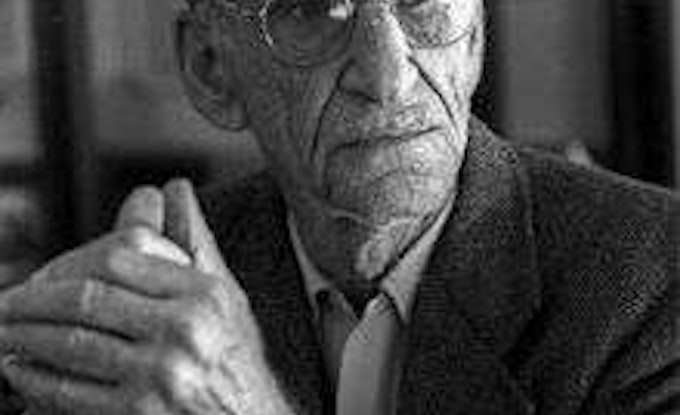
We’ve been reading Michael Davidson’s superb anthology of George Oppen’s verse, Collected Poems, forcing me to the keyboard to ponder some connection with Wallace Stevens . with whom he shares an obsession with how the human personality tries to speak to those things that will never let themselves be revealed.The massive solitude in Oppen's work, wholly devoid of Romantic despair, seems an intrinsic part of his recognition that the Earth itself can never be known.Oppen is connected to Wallace Stevens, I think, in that there is awareness that language has the habit of taking on the personality and delusions of the speaker and thus disguises nature, "reality" under layers of wordy assumptions that miss the mark of the mystery of experience. Stevens, though, exults in his search and wonder, and views the finalizing that eludes him as occasion for joy, wonder, a reason to intensify one's attention on the very nature of being in the world; Stevens thinks it enough for the witness to be staggered by the realization that existence is absent of final, metaphysically fixed perimeters, and that one should relish the more profound miracles in the details of their own senses.
Oppen comes to know his loneliness, and there is in his work some longing for old myths that gave comfort to a restless mind. Oppen, though, denies the lure of nostalgia and presses forward on some path that has an end only beyond his own death, that language will be restored to it's ability to correctly assess the world and ourselves in it, and avail us with some ideas of assembling a world that operates on good acts and deeds and not a high rhetoric that amounts to sighing, whimpering and casual bad faith, in Oppen's estimation.I'd be interested to hear your ideas regarding Oppen's path that leads beyond his own death, as that seems alien to his poetry, at least as far as it refers to poetry.A bad habit of mine is to use dramatic language when I'm the full boil of writing, so forgive me for possible vagueness and overstatement. I am thinking , of course, of Oppen's leftist politics and his association with what's come to be called the Objectivist movement, spearheaded by Louis Zukofsky, and whose members, as such, included Charles Reznikoff, Carl Rakosi, with older American modernists such as W.C. Williams and Pound having close affiliations with this loosely defined group of writers.In the broadest sense, Objectivist writers, following Zukofsky's lead, developed styles that evolved from Imagism, but sought to come up with a kind of unblinkered epic poetry that wasn't hampered the symbolic obscurantism. The idea was to write, according the poet's personality, a verse that presents concrete things and realities not for the purpose of making them mere props for some metaphorical system whose results wind up with dead tropes and forgone conclusions that reaffirm only bad faith, but rather gloried in those things and their uniqueness.
Zukofsky, along with Charles Olson, sought to expand the aesthetic into the social areas, the geographical, into areas the names of which define us in relation to nature and the world humans build within it. Where a modernist like Pound (as opposed to Stevens) sought to legitimize the poet as an insurmountable authority on the exactness of nature and meaning and hence establishing him or her as an arbiter of Power, Oppen's wanted to use his poetics to make the discerning habit of mind, the ability to use language in unsentimental ways, to the general population. This would have been his ultimate gift of love, and there is a tone in his writing that I get, sometimes, that he is aware that such revolutions are started in one's lifetime but often not finished. I've no doubt that he wished that what started as a preferred compositional practice would grow into a self-renewing alignment of the population's right-sized perception of itself within Nature. Some of that loneliness might as a result abate. Zukofsky, Oppen and the work of the Objectivist Poets, as such, are a huge influence on the work of the L=A=N=G=U=A=G=E Poets, whose ranks include that charged inversions,reversals and redirected practice of Ron Silliman, Rae Armentrout, Bob Perelman, and Michael Davidson himself. It's a stretch to refer to these poets as a school or movement at all, which is why I preface the remark with the tired qualifier "In the broadest sense...."
These poets come at time when the American modernists were getting older and their ideas had been assimilated by a younger generation. The poets share some similar attitudes regarding poetic language and the quest for unassailable truth, but calling them a coherent movement is a stretch, as you say; literary critics, needing to classify styles and writers, pounced on "Objectivism" as a the term to use, and in fact wrote the manifesto, in the form of their varied systematized remarks, that Zukofsky et al never got around to composing. The poets were off into the American wilderness, distinct in style, attack, voice. Oppen's attraction to the general attitude with the Objectivists, to compose a phonologically responsible poetry, is understandable, but his personality and his style are his own, after the association. It might also be said that Oppen's poetry is the best of this generation of writers
L=A=N=G=U=A=G=E poetry, unlike what's been called Objectivistism, was an actual poetry movement, replete with manifestos, several anthologies, and an intimidating backlog of criticism and commentary by the poets themselves addressing what are conspicuously shared ideas and aims, stated succinctly as this: the theme of Language poetry is language.It was an inevitable development, I'd guess, coming out of the Sixties new left affiliations, and riding in along the tide of structuralist -inspired art where making a consume aware of the art's own mechanisms and intentions, was a common card to play; along with the writings of Ron Sukenic, Barthelme, and the films of Godard and Snow, Language Poets seemed to think that exposing the mechanics of syntax and grammar would make readers aware of how they're being manipulated.
Not a bad idea, perhaps, but it's something that expressed whatever was interesting it had rather quickly. Lately, it seems more a strong addition to a poet's resume so they can acquire an academic position. Not surprisingly, there are younger student poets who've been seduced into this style, and one prays they move from the semi-Marxist psycholinguistic braying of that peculiar school and find their own voice, through which they can trust the authority of their senses
Thursday, March 5, 2020
TWO ABOUT MICHAEL RYAN
Someone recently tossed out the coffee mug I kept at work, a cracked and infirm piece of pottery that had seen better days and superior cups of coffee than the foul brew that fills the break room with a the aroma of soggy scorched grounds. I didn't, though, mourn a bit, did not muse with tortuously extended metaphors over what the loss represented symbolically, was not , generally, willing to attempt the ironic connection between the manufacturing process and region of origin with ego-political concerns that are relevant, it seems, in another conversation.
What I thought was that crap, my cup is gone, dirty and cracked as it was, someone tossed my private property, it was mine, ugly and gross as it had become, it was my cup and it was my coffee that would have been in it on the fifteen minute break I am allowed by law but no, I am denied that, I am without coffee and now I have to go to the machine in the hallway and drink something less savory than the brackish blend our staff coffee pot contains. And that was it; my concern was local, not global, my solution was to move on to the next indicated thing, getting coffee from the machine and some minor-key grousing, not, shall we say, writing a paean to a cup that is, when all is said in done, only a material stand in for other matters, global and personal, that poet Michael Ryan can drum up in the composing of his poem "Mug".
There is a sense that Ryan wants to offer up a concentrated rant of a kind, an Albert Barth style tirade (or offer a tribute to John Ashbery with an investigation of how his mind associates the present world with the chambers of history the mind stores in so many sequestered boxes) in miniature, but even here this poem swells with literary bloat. Nothing sounds natural; there is no comic timing, no pauses for effect. There is the padded vocabulary of winking sarcasm that hides a contempt for the whole subject matter of ownership and the constructed ironies contained in the concept with grandiloquence , the hollow elegance of someone writing until a good line appears. All told, Michael Ryan would have done better by reducing this poem to something much sparser, nearly skeletal.Better to leave the bloggy-asides out of the poem, I think, and leave the reader something truly tactile, visual and genuinely provocative as a result. The poem has lots of one liners, but lacks a single idea we can walk away with.
_______________________________________
Michael Ryan admires Emily Dickens, it appears, but there’s nothing in his poem“My Young Mother” that comes near the compressed internalization the Amherst mistress created with her jump-cut , cat- footed leaps between ideas. Dickens, for sure, was a writer one stayed with, labored over, argued with in terms of the uncompromising nature of the style and then and only then grasped her cadences and the burrowing revelations they contained; one was rewarded as well with a stinging wit that was properly lacerating once it was released from it’s coded sheath.
There are, to say the least, considerable rewards for the close inspection of her unusual diction and involuted construction. Ryan fares much less trying to write with a suggestion of her style—it’s the subject for emulation that is the least likely to produce interesting results—and where Dickens had the skill to keep one guess, unsure, strung along as to what her point would be or what it was that might be revealed (the peculiar joy of Dickens is the teasing, the delayed gratification), Ryan’s poem confesses his meanings and intents readily. There is no suspense in the game here, nothing that caste a different light on memories that are clear but clouded somehow with intervening events. There is, instead, a mannered and stiff rendering of a childhood memory I can’t help but think unfolds from Ryan with too much detail,
There are, to say the least, considerable rewards for the close inspection of her unusual diction and involuted construction. Ryan fares much less trying to write with a suggestion of her style—it’s the subject for emulation that is the least likely to produce interesting results—and where Dickens had the skill to keep one guess, unsure, strung along as to what her point would be or what it was that might be revealed (the peculiar joy of Dickens is the teasing, the delayed gratification), Ryan’s poem confesses his meanings and intents readily. There is no suspense in the game here, nothing that caste a different light on memories that are clear but clouded somehow with intervening events. There is, instead, a mannered and stiff rendering of a childhood memory I can’t help but think unfolds from Ryan with too much detail,
What she couldn't give me
she gave me those long nights
she sat up with me feverish
and sweating in my sleep
when I had no idea whatsoever
what she had to do to suffer
the pain her body dealt her
to assuage the pain in mine.
The writing is too fussed-over, the particulars too polished, the narrative constructed in such a way that one knows that there is a punch line coming by the usual literary routes.Ryan continues an argument he seems to have been having with his mother over the years and finds himself in the grasp of swooning revelation that a handy device has landed at his feet to aid him in bringing a coherent (if game footed) line to his left over recollection. He senses his mother resents her requirement to remain with her sick child but remains so through an instilled sense of obligation and duty, instincts she likewise resents.
That was a noble privacy—
her mothering as a practice of patience—
how deeply it must have stretched her
to watch me all night with her nerves
crying for rest while my fever
spiked under the washcloths
she passed between my forehead
and her dishpan filled with ice.
Ryan attempts a feint her with the last stanza, doing as Dickens does by at first seeming to address a subject in a way that suggests a praising tone , and then , against expectation,turn to the other extreme , although in Dickens case, the “other extreme” wasn’t extreme in the writing, but rather swiftly, deftly, ingeniously offered. The effect was of someone changing their mind about someone or something, but credibly so, with some evidence visible from the argument the speaker had advanced in their initial praise of the subject. Ryan’s attempt to address a darker side of what he’s set up in the previous stanza , the conspicuously moldy conceit of the Sainted Mother, is ham handed at best, and bizarre.
That was a noble privacy,
but even then there was so much
unsayable between us,
and why this was now looks so
ludicrous in its old costume of shame
that I wish not that she had just
said it but that I hadn't been
so furious she couldn't.
We find now that he resents his mother because she was putting her child before her own needs and desires and that she did so without protest, but that the child Michael was sensitive enough, aware enough at the time that she was disguising her true feelings, was, in a sense, being false with him and now he has the lingering simmer of a resentment that she couldn’t speak to him , mother to child. There are those folks in various twelve step programs who “get stuck at the fourth step”, the writing of a fearless and searching moral inventory of themselves where one’s foul deeds, resentments, traumas and what have you are written out with a brutal honesty , the goal being that one may face their demons (to risk a cliché) and work through those matters that impede their progress.
The goal is progress, to move on and make a life for oneself that’s worth living, not to assign blame to those who’ve beset you with life-hobbling “issues”. But there are those many who continue to dig for bones in the backyard and continue to contrive new odious scenarios from scant fragments; it basically turns these people’s lives into conspiracy theories where forces have aligned to make one’s life a punishment. Ryan sounds like he’s stuck on some matters that he would have been better ridding himself of once and for all; the point of an inventory is for an enterprise to rid itself of goods that cannot be sold if it is to remain a going concernExaggeration often times benefits a poem , and in fact that is often the point of engaging in this peculiar form, but Ryan doesn't make me want to suspend my disbelief or to dissociate my sensibilities precisely because the thinly constructed and blatantly contrived nature of the punchline,which was the supposedly stultifying effects of his mother's care for him. The poem is whining, really, the sort of who can't help but feel ennobled by their self-diagnosed dysfunction. It's an easy way to give your life a narrative arc, an originally source, from which a limitless flow of causes and effects can be writ, most of pat and phony. “My Young Mother” seems to be an example of someone inventing evidence that he’d been done a foul deed; the result is an awkward and ludicrously reasoned poem. Some things can only be written off when all is done , and as someone who manages bookstores, the ridding oneself finally of what cannot be made good use is a relief.the tone of Ryan's poem is weepy and woe-is-me, and my experience in the programs I alluded to in my initial post has presented me with those for whom their issues, whether alcoholism, drug addiction, codependency or child abuse, is a form of identity politics. There is a power in the brand, as it gives one a world view and provides license for one to rummage through their past and invent further originating sources of their dismaying existence. It might well be that Ryan intended anaha! in all this, that something is revealed, but what I take to be an unsettled issue keeps him on the fence in the form of the equivocating language he selects. It remains in dysfunction; if the matter here was settled Ryan would have the instinct to offer up a portrait of a "fully formed man" that would have resulted from his struggles. But he doesn't, and the poem ends only with the feeling that this is a man who can become weepy because he chooses to be so.


Monday, March 2, 2020
WHAT POETS DREAM ABOUT
 Poets dream about writing poems about moonlight , still waters , vapor escaping from a yawning mouth on a cold night , love that will not reciprocate no matter the intensity or rigidity of your yearning and, I wager, writing poems about poems besides said still waters, under said moonlight. You write about what you know about, so goes the advice, and it often seems that all the poet knows about is his medium and the mewling, drooling, soft headed language required to fill pages and eventually books with the kind of poetry that is steadfastly unsure in what it wants to say, or at least get at.
It is, however, not a situation isolated to the New Yorker, as it is a habit of mind that filters through the versifying consciousness regardless of politics, preference, or where the poet thinks they are in the relative standards of quality. Save for the few instances where the habit results in a brilliant gem of cadenced self-reflection, it is the worst sort of navel gazing, to employ a cliché. To employ a fresher simile, it's the drone of a specialist of who cannot talk about anything else. Poets are supposed to have mastered their craft and then enter the world. Too many of the writers that find sanctuary in the journals have reversed the process. I am not against difficulty, I am not in favor of dumbing- down poems in order to attract larger readerships, and I don't think the non-specialist reader insist, as a class, that poets have their wear as unadorned as sports writing. The gripe is against the poet who cannot get away from making Poetry their principal subject matter, by name. Not that each poem about poetry is, by default, wretched; there are bright and amazing reflexive verses indeed, but they are the exception to the rule, the rule being that a medium that ponders it's own form and techniques and ideological nuances too long becomes tediously generic. The problem, it seems to me, is that some writers who haven't the experiences or materials to bring to draw from will wax on poetry and its slippery tones as a way of coming to an instant complexity. Rather than process a subject through whatever filters and tropes they choose to use and arrive at a complexity that embraces the tangible and the insoluble, one instead decides to study the sidewalk they're walking on rather on where it is they were going in the first place.
I rather love ambiguity, the indefinite, the oblique, the elusive, and I do think poetry can be ruthlessly extended in it's rhetorical configuration to encompass each poet's voice and unique experience; the complexity I like, though, has to be earned, which is to say that I would prefer poets engage the ambivalence and incongruities in a sphere recognizable as the world they live in. First there was the word, we might agree. But those words helped us construct a reality that has a reality of its own, and I am more attracted to the writer who has tired of spinning their self-reflectivity tires and goes into that already-strange world and field test their language skills.
Wallace Stevens, perhaps the most beautifully oblique poet America has produced, can be said to have written poems about poems, but I think that misses the point. Our latter day mainstream reflexives are enamored of the their own broad readings and wind up standing outside of poetry thinking they have a better idea to what a poem should be. The concern isn’t the poem, but the abstraction, an inversion that has the erudition outsmarting the inspiration. Stevens was smart enough to familiarize himself with the philosophical propositions regarding the problems associated with the world we see and the world as-is; his genius was that he created a metaphorical systems that could deal with poetics-as-subject and still give us something beautiful and wholly musical.
I am beginning to suspect that the problem might not be that poets are writing too many poems about poetry--the tradition for the bard to reflect on his craft and his relevance is very long established in world literary history--but that of the tendency of editors to select or solicit these sorts of works. If one looks further into the works of the New Yorker poets cited in the story, one would notice that they respectively manage to engage life outside their craft ; the body of work is not always the excluding, suffocating lone idea as it may seem here. Editors, I am tending to think, need to be more open ended as to the subject matter they consider suitable for the magazines or journals they write for.
Subscribe to:
Posts (Atom)