Thursday, December 8, 2022

SOME QUESTIONS I WAS ASKED AND THE ANSWERS I GAVE


What did you discover about yourself while writing your poem?

Usually, I write to find out what comes after the sentence after the one I just wrote. I have a particular set of strategies, notions of musical phrase, cadence, rhythm, and structure I’ve developed over a good many years—and this isn’t implied that I’ve mastered this form of poetry, free, at all — and I’ve internalized these linguistic habits much as a jazz musician internalizes his training and notions of theory; I come up with a first line and consider what object, word, image, attitude it contains and try to imagine what sounds musical and rhythmic and a logical expansion on the details the first sentence contains. It’s theme and variation, improvisation of a sort in the moment of creation, seeing where the initial idea takes me, stanza to stanza, until I come to a place to a poem where it can end with a resolution (or irresolution) that satisfies me, and perhaps satisfies a reader. What I discover about myself is that there is another way to explore emotion, experience, spiritual and philosophical concepts without resorting to the mechanical language of the academy.

How can I take the line "my shadows hold the wisdom of a crow's mysterious intelligence" for a line in a poem and make it more poetic with the use of allusion and metaphor?

You can’t redeem this line, no matter how hard you might labor, not if you want to write a good poem. This is the kind of image someone new to writing poetry often writes when they’re trying to be/sound profound. Never try to sound smart, learned, philosophical in a poem: effective lines that resonate with readers on more profound concepts come from the best and most effective use of language to get across experiences and notions that are not easily conveyed through conventional prose. “No ideas but in things” is how master American poet William Carlos Williams put it. Let the object, that thing in the world that is in the situation being written about, be itself, without the flimsy abstraction. Read Williams, read TS Eliot, read H.D. and come to understand the way each is using language, and understand as well not just what they’re saying but also what they're leaving out. But trying to shoe horn a line you think is profound into a poem, a line that attempts to make a big statement, will only result in an awful poem. Be more direct, get rid of the “literary” language. And if a phrase comes too easily to you in the writing, get rid of it. Avoid the trite, the clichéd, the abstract. Have your poems come out as clear statements of experience, convincing recollections, not crowded with weak attempts at a higher language.

Does a knowledge of correct matter if you're writing poetry?

Of course, it does. There is the notion that poetry is an expressive free for wall where the rules of grammar don’t matter, and this is incorrect. Writing poetry, whether you’re a new formalist, a romantic, a practitioner of avant gard strategies, a fan of rhyming or someone ruthlessly in the camp of the free versers, is writing, a means of communicating to the reader. I'm a believer that one has to know the rules of the game before they discard them, too. A knowledge of correct grammar, of how to most cogently compose your thoughts and make them ready for the world, provides you with a working knowledge of forms, structures, gives you access to effective rhythmic devices, gives you a proper sense of how to use metaphor and simile. We all know, of course, that great jazz musicians like Charlie Parker and John Coltrane didn’t just get up on the band stand and start honking away ; their brilliant improvisations were based on profound knowledge of music theory and harmony, and based on relentless wood shedding, of practice in an effort to strengthen their skills as jazz improvisers. Their knowledge of music forms were internalized and gave them tools to compose their greatest sorties. The same goes for poetry. Every poet I’ve admired and studied—Eliot, Stevens, Shakespeare, Laux, Ginsberg, Baraka, HD—understood the fundamentals of writing and could work their way around the rules ; their writing was great, singular, and utterly fresh until now because their innovations acknowledged the traditions which had come before even as the poets broke away from them create their own work.


What's the difference between free form poetry and free verse poetry?

Free form poetry is a term used by terrible scribblers to hide the fact that they haven’t the faintest idea of what constitutes a good poem. Free form poetry will feature unrestrained expression, an excess of emotion, either show itself to be clogged up in clichés, sentimentality and bathos, or it can be utterly impenetrable in regard to any kind of readability or coherence. Many free form stanza writers will justify their cryptic, ungrammatical , spiteful, rigorously incomprehensible efforts as being “experimental” or “avant garde”: the gruel schleppers who use words like that are often eccentric, show an inability to accept advice for suggestions that might help them become better writers. Free form poetry is without craft, it is without art or any kind of creative integrity. It is the writing equivalent of puking, where all that awful, dreadful, disgusting stuff is just emptied onto the page without regard to revision.Free verse poets, the great free verse writers—Whitman, Dorianne Laux, TS Eliot, Ginsberg, WC Williams, Amiri Baraka, John Ashbery, many others—understand the fundamental techniques of writing poems, have been long time students of other great poets and have studied their methods in a variety of ways and have, in turn, mastered the techniques themselves. These are matters of rhythm, scansion, scale, the varying ways in which one uses metaphor, simile, allusion, and allegory among other facets. I could go on, but the free verse poets are real poets because though they don’t rhyme and there are shifting notions of pacing and rhythm that are obvious in their verse, there is also a clear understanding of techniques that they’ve made their own and have used to create their respective voices , the point of all that being is that its obvious there is skill , craft, and real inventive language being used to bring the reader into the poem, into the journey of ideas and feelings the well-written poem can evoke. Not every free verse poet is a great writer—as with any other art form, there are standards by which an artist is judged by reader and critics, and the simple fact of it all is that not everything is a work of genius. But it must also be said that the least of the free verse poets have at least an understanding of the craft and long history of poetry. Free formers do not, as a rule , and that’s a sad fact.


What did Charles Bukowski mean by "failure is freedom"?

It should be obvious if you’re familiar with Bukowski’s writings. As his recurring character Hank Chinasky wanted to do nothing more but play the ponies, drink, have drunk sex and sometimes write a poem, failing at something, a job, a marriage, a promise, some commitment to lead a responsible and principle life, frees you from the pressures of having to measure up and allows you to become something that isn’t scripted. Laziness, sloth, self-loathing, and inebriation were more honest things to be in this existence . You only had to be your smelly, repulsive self. If you and others have low or no expectations about you, the margin of disappointment is very low or nonexistent.

Wednesday, November 23, 2022

A POEM BY JAY ALLYN ROSSER

 Clumsy titles don't grab me at, but it's useful to see if the ill-phrases follows suit in the actual work. Fortunately, J. Allyn Rosser's poem After the Service, the Widow Considers the Etymology of the Word Salary , published in Slate in 2009,transcends the gabby quaintness. For starters, I would have junked the original title of this poem had I written and instead stared at the finished piece for a few moments, finally relying on the old trick of making the last full phrase of the poem the name of the piece. In this case, "Sighs for My Meat". Odd, strange, a communication from someone who can't find the words, this alternate title fits the Eliotesque tone of exhaustion, ennui, boredom that barely conceals the feeling that inevitable death is catching up with them. Too many poets consider the purposeless disguising of meaning to be enough to make a poem and to force it, even though private language isn't always an element that makes for a good poem. One is, of course, compelled to fill in the blanks, but we do get the gist, we get a crystallized essence, that of someone alone, after a service, returning to the daily rituals and routines where the familiar things are made strange, foreboding.

This morning began like anyone's:
coffee. Mine a bitter roast
too weak for the daytime
that keeps me up half the night.

The coffee is meant to give purpose to one's day, but it only ruins one's waking hours and time of sleep, and tastes bitter, as she knows half-sleep is not good for you. The days ahead are approached with caution, a creeping dread that changes the flavor of what's in the cabinet.

Back home, I liven things up
by microwaving popcorn:
an edible jazz I feed to the trash
for our walk to the curb.

It's not hard to see why the small matters that might have made home life a joy in the past seem a burden now, but it's an attempt to distract one from the core set. All the things we make become waste, all things of this earth return to the earth.

At the end of the day, one shadow
seems made of a deeper gray:
have I somehow earned this
by refusing for years to fear it?

I was speaking to a friend the other night on the matter of aging and he, a robust 70-year-old, remarked that he is at the point in his life where half the people he's ever known, his age, are dead. To combat his despair, he remains active: his hand goes out toward new friendships all the time; at times this seems like a mild mania he suffers from and one wonders how convincingly he can become best friends with a host of associates he's known only scant years and who, generally, are fifteen to twenty years his junior. But he smiles, this man who's been to many funerals, he is gracious, he is engaged with his world and community and he, perhaps, has found something that essence that of attitude, of spirit, that prevents the objects of his world from becoming harbingers, reminders, latent symbols of demise. But Rosser's speaker hasn't this resilience, a creature of habit for whom the familiar items seem merely to taunt and withhold truths. There is a parsing of the words one uses to describe their quality of being--a dissection, in other words, of something that is already dead.

Here at last my martini
embalming its hollowed olive,
and, as apparently originally intended,
salt for my salary, sighs for my meat.

A martini, embalming, a hollowed olive, the price one has paid for their life, salt for the meat, we have a language that finds itself conflated, with meanings and emphasis spilling over one another, a pickled narrator pondering the inevitable from the standpoint of something that is not living in any vital way but merely preserved. Rosser's language is masterfully exact in the sort of round-robin associations these bouts of pronounced foreboding can bring. This flesh is scarred, embattled, without a determining will to make a change this late in life, this flesh is tired, wounded. This is the internal narrative of someone waiting for the other shoe to fall.

Saturday, November 19, 2022

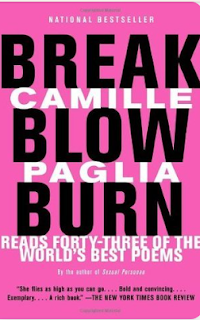
 I've said some rude things about Camille Paglia when the academic-turned-public intellectual was a regular columnist at Salon.com. I was berating her for basically wasting the opportunity to be smart about cultural and political issues by lavishing each form of self flattery. To court cliché, even Norman Mailer has more modesty. I haven't changed my mind, but I should mention her 2005 collection of poetry criticism, Break, Blow, Burn. It's the liveliest collection of critical remarks I've in years. Camille Paglia published her collection of poetry essays Break, Blow, Burn (now in paperback) in 2005, and straight away there were those neoconservatives who seized upon the firebrand professor as one of their own, someone to bring "reason" back to the classroom.It was hoped in some discussion groups I've recently emerged from that Paglia is Sanity itself, ready to unfasten the choke hold of incomprehension that's been around literary criticism for decades. The short version of all that conversation was that Paglia would be the celebrity academic intellectual who would sift through the Great Books and present a straying society the Values and Virtues William Bennett cherishes almost as much as he does a solid poker hand and a stall stack of chips. Hold the phone. I don't think Paglia represents "a voice of reason", since the word "reason" is the last thing you want to apply to a close reading of a poet's work. It implies, by default, rationality, and it's never been the poet's assignment to reason through experience as if he or she were a scientist trying to classify and categorize the world about them.

Rather, poets, good poets, and their work continue to attract us because of the way in which they usurp the instructed ordering aspects of language and instead find ways to integrate what is seemingly inexpressible, felt experience, the "interiority" of being, with what is observed in the factual being. It's perilously hard poetry to write successfully and, even when it's done well, reviewers toward totalizing, sense-making totems that bring a reasonable and agreeable sheen of coherence to a work; the way we've come to discuss poems falls too often in the smelly troughs of conventional wisdom, received perceptions, cracker-barrel philosophy, simplistic and simple-minded platitudes, all of which are devised, by consensus or conspiracy for readers and reviewers, to have the world remain entirely comprehensible and sane.

The voice of reason is the enemy of good poetry, and that is what Camille Paglia knows better than any other commentator; a poet, she argues in Break, Blow Burn (now in paperback) is that a poet, though a conscious and determining artist, acts nonetheless as a conduit for the wild strands of personal narrative, religion, myth, comprehensible realism, rage, philosophy merge, blend, twine and twist in the same discussion. Poetry is the language of unreason, another way of taking the pulse of the culture as seen from the particular and individual poet's voice who lives within and yet is compelled to view it askew. The essays in Break Blow Burn argue that the poems under review are not required to "make sense", to deliver a singular meaning, easily digested and disposed of, but exist instead to provide a subtler, more nuanced , more complex sense of what experience entails. Many ideas from many sources come to bear on a poem's thesis, and Paglia pulls them out, addresses them, and demonstrates the fascinating dialectic of the way ideas, images, expressions and varied idioms influence one another, offer shades of inference, change meanings.

It wasn't enough that the national discussion on poetry was already pathetic and contrived, a contest between assorted second and third generation splinter groups of specialized enclaves trying to inhale what was left of the air in the tiny room where the debate raged. Amazingly, the conversation had become as dumb as it was insulated. In the 2001, the New Agers and refugees from shoe gazing concerts got into the act with the publication of Roger Housden's slim collection Ten Poems to Change Your Life, in which he presented the undefined general reader with a set of poems, varied to gender, nationality, religion, lifestyle orientation, that they might consider between errands and cell phone chats:" The Journey" by Mary Oliver ,"Last Night as I Was Sleeping," by Antonio Machado, "Song of Myself" by Walt Whitman ,"Zero Circle" by Rumi, "The Time Before Death" by Kabir,"Ode to My Socks" by Pablo Neruda , "Last Gods" by Galway Kinnell, "For the Anniversary of My Death" by W. S. Merwin, "Love After Love" by Derek Walcott "The Dark Night" by St. John of the Cross .

A high-quality selection, give or take exceptions according to tastes, but Housden's intent seemed less to introduce readers to the wonders and varieties of perspective poetry might offer than to bring us to the lectern where he would deliver his Message of the Day. Following each poem, there was a light discussion of the life's circumstances the preceding poet wrote about and Housden would extrapolate through a number of nimbly massaged points of literature, theology, popular spirituality, to give the imagined reader a broader perspective, a moment's respite from that crackle and insistence of contemporary consumption. The aim of the collection, hardly surprising, was to have the stressed audience abandon their cell phones, lap tops, and exercise equipment and make time to smell the roses before they were gone , trampled under the heel of progress.

It's not an original premise, but it remains sage advice all the same, and one could for the moment put their disdain for the use of a poet's work as fodder for a feel-good mill, although containing the contempt was harder than it would seem. The irony was that the fresh perspectives, the original language use, the carefully crafted evidence of subtle intelligence interrogating the problematic nature of existence was being used as another means of delivering readers to insights they already know. One hoped, even prayed, one hid under sheets of wishful thinking; any way of bringing readers to quality poets was worth a bit of pimping by an enterprising editor and motivational guru. Or was it?The problem remained that the skewed thinking that characterizes much of the best work would only confuse and further complicated the world for an audience that wanted assurances, not ironies from what they read and reflected upon. The mind was already a roiling with contradiction and discontent. Housden's editorial genius was his ability to ignore problematic subject and stir his declarations skyward, looking over the hill for the displaced Gods who formerly assured us a coherent world.

Ten Poems to Change Your Life turned into a series of five similarly named collections, a choice gathering of poets per volume, followed by Houston's compulsively upbeat chats. A gimmick has been established for Housden and was performing handsomely—the books, pocket sized, were perfect for bookstore cash register stands as impulse purchases, and in the dozens.

One despaired seeing that Housden's books sold while the poetry section remained the slowest selling in the store where one worked; the audience was ready to read one poem by Walt Whitman and absorb a slight ration of cracker barrel spiritualism as an afterward, but such readers weren't inclined to pick up Leaves of Grass and do their thinking. Housden's audience is one that wants to be told what things mean. Housden's brilliance isn't what he says about the poems but rather in recognizing an area of mild interest to big audiences that hadn't been adequately exploited and denuded of any possibility of inspiring even a minor itch.

It was enough to make one wants to give up the game entirely and watch DVD reissues instead, but there is a blast of fresh air coming through the room, Camille Paglia's Break , Blow, Burn, a collection of forty-three poems brought together for a close reading by the author. Paglia is a humanities professor at University of the Arts in Philadelphia, and made her entrance on the national stage with the publication of her bulging, bombastic and usually brilliant book Sexual Personae, a sprawling study of sexual identity, its profound effect on art and culture, and the endless way that it's been disguised and altered. Personae was maddening in all its phases and investigations, with theories and declarations worthy of full dissertations popping up every few pages, yet no matter how one read her breathless , in-your-face explications that every proverbial pore of existence, society, and culture was dripped with sexuality (repressed or blatant), you couldn't dismiss with the usual brush-off .

Paglia's basic thesis about the best way to appreciate poems is to stop worshiping reputations and the sordid prestige that comes and begin instead to read and think about particular poems. Hers isn't a sensibility to bow to fashion or some one's deeply intoned name; fame and a gimmick will not acquaint the poet under review any slack. As she says in the preface, what she believes in are great poems, of themselves, separate from larger bodies of work. What we get in the forty-one essays in Break, Blow, Burn are her intense, close readings of what she regards as the best poems in English; the selection and the arrangement of what these "best" poems come to be won't satisfy every taste or notion of what honestly comprises the best work, but Paglia didn't write these missives to cosign every lazy idea we've had about poets and their work.These are her favorites, using her criteria, and quite unlike many skimpy or corpulent collections slapped between covers to satisfy a fleeting fashion, she will lay her arguments in solid, comprehensible and far-flung terms, returning again, again and yet again to the respective poems she's reviewing. Less a medium to make us feel warm and secure, her poems have to do with an extreme engagement with life on life's terms. Whether finding whole worlds of secular metaphysics contained in the few lines of Wallace Stevens' "Anecdote of a Jar," sweetly limning the edgy and cavalierly erotic voyeurism of Paul Blackburn's "The Once Over" or marveling at the triple tiered city speak of Frank O'Hara's fantasy "A Mexican Guitar," Paglia discusses each of the poet's work as points in which spiritual certainty and intellectual pragmatism come into conflict, war with one another, and emerge by poem's conclusion with some third perception larger than the opposing inclinations which reveal a finer, more complex, less fixed situation for the human condition. In each case, Paglia follows the poet in the process of bringing together the poem, their process of perception, beginning with what was observed, the associations the image conjures or suggests, and delicately observing how the poet controls their associations, no less careful than a great composer, giving play to the various senses and associations each phrase and delicious reference appeals to.Paglia's genius , if that's it to be called, is her ability to recreate the poet's thinking at the moment of composition. This makes her discussions intimate, vital, a whirlwind of excited speculation.

Flux, change, destruction, growth, all the things that make the up the endlessly repeated cycles of death and birth, are what connect these poems, and Paglia , in these vividly studied pieces, isn't about to let any of us slide by with only a nodding acquaintance with what a poem can mean as well as be. Her view of art is that it increases our awareness of life's enormity, not reduces it to some meager paragraphs of ego massage, and it's a good thing that she was willing to put her notoriety on the line in introducing some rigor into the general chat. Finally, what is especially inspiring in Paglia's fierce arguments is her refusal to grant the readers slack. None of this material is over your head, she seems to insist, Get on the ladder and see what's out there.

Monday, October 31, 2022

WEIGHTY AND LEAD FOOTED

 "The Unfortunates" by poet Cates Marvin, is a sad tale of sensitive people who are overwhelmed by life's cruel tricks to make them feel bad and keep them awake at nights contemplating what is horrible, ugly, and unfortunate in the cities they live in. It is not to my liking , mostly because the poet, Cates Marvin, tries to find some equal ground between herself (and those she presumes to speak for) and the homeless she espies whose misery gives her the jitters and attending guilt feelings, to which I say no dice. These steamy, cold streets are the mean ones better writers than Marvin, or me have walked down before, and they've managed to absorb the steaminess and squalor of their life and, depressed or no, didn't obsess on their frayed nerves. Their anxiety wasn't the subject, but an entrée to another topic. Marvin sticks with the frayed nerves, and that makes the poem a chore to read even once. It's a straining, over stocked equation; after spending the first stanza presenting the pathetic detailing the doings of the sad creatures he pities in ways that make them sound exotic, alien and strange, the second stanza smacks us across the face with slippery buckets of self-reflection in which Marvin, or the poet's stand in, waxes and whines on how this saps the vitality, makes the soul sink, and essentially turns sleep into a rehearsal for death:

Those hours we haggle,
wondering when the sincerity of sky's blue
will arrive, how come nobody's bothered to
repair the loose latch on the front gate, and
what kinds of eyes melancholy lovers have.

There is enough baloney here to make a hundred Salvation Army sandwiches. And for his sleep, one wonders why she doesn't buy ear plugs and a new mattress. Fragile poets are nothing new to verse and one ought not condemn them outright for their confessions of bad serves and upset equilibrium, but Marvin is neither Eliot nor Plath nor John Berryman , all three of whom could do more with their depressed witness to harsh facts and resulting sets of despair with remarkable self-reflection; the result was an honest poetry of personal exploration, and none of them, I recall, used the facts of poverty or squalor as a pretext to wallow in the kind of makeshift misery Marvin has concocted.

 It helps us to remember that Samuel Beckett's plays, novels, and poems were about those situations that have sapped us of our will to live creatively and makes a continued life of drudgery unthinkable to bear, and yet we do, getting up each day to face the same repetitious humiliations not from any courage to stay the course but because, more plainly, less gloriously, much more banally we cannot think of anything more interesting to do with our days. From this, Beckett gives us great comedy and creates a language of men that is more animal instinct than discourse; he digs within the sour mood of dread and drudgery and reveals sentences as loud and fragmented and repeated at odd intervals to kill what small spark of truth still rests in us, dormant. Beckett , unlike Marvin, reveals nothing apart from antics and absurdity, the rituals and recitations of characters keeping themselves distracted against a yawning chasm. Marvin can't stop talking about it and her feelings, and this quality, this yakkity yak she provides us does nothing to make you care or make you stay interested in the struggle. 

The intent of the subject makes her lines lead-footed, with some comically awful alliteration.", malice moves like mice…" is noteworthy not for evoking states of depression and ennui, but rather of old cartoons where the mice come out of their hiding places after the lights are out and throw one hell of a party). It's not a good fit at all, and somehow I'm dubious to Marvin's intent with the poem. The message is less about economic injustice than it is Marvin's feelings of powerlessness, which is fine in itself, but powerlessness in and of itself should not result in this kind of static, powerless writing.

Friday, October 21, 2022

SPARE THE ROD?

It's been famously remarked that writer Rod McKuen was "America's  most understood poet". It was a smug bit of left-handed complimenting, a crack appearing to underscore the rosier, more banal, more hypnotically obvious this man's verse was. The proper poets, academics, and critics of the era, the 70s, considered what McKuen as worse than fresh spit. The irony, you'd think, was that he cried all the way to the bank, as he was among the best-selling living authors in history. Rod M. became quite a one-man industry, with books, records, greeting cards, calendars, movie scores, long sell out tours on a global scale. Who was laughing last? Barry Alfonso's 2019 biography of the writer, A Voice from the Warm: The Life of Rod McKuen,  spent a good amount of time researching the many claims the poet made about his life and finds a personality more complex and melancholic than  one might suspect. Slate, the online culture and news magazine, additionally published an article asking why is it that we, collectively, do remember or at least mention a man who was, at one time, the most popular writer in the world. It's not that I've come to love McKuen's poetry more than I had, but this attention has made me consider the influence the bard has had on my growing desire to be a writer of some measure.

It's worth sharing, I think, that McKuen was a gateway to a larger lifelong experience with poetry; he was a primary influence in motivating me to write and eventually publish my poems over the last several decades. My early influences were a mixed bag of styles, beginning with Dylan's bucolic surrealism, up to Eliot's fractured, despairing modernism, Ginsberg, of course, and critically, McKuen's solipsistic romanticism. 

I was fifteen or sixteen, a choice age to get obsessed with feeling unique alone in the world, and McKuen was the poet I related to most because his persona was more cinematic than poetic. Even then, I imagined this character after hours, walking the waterfront in a thick fog, harbor lights and neon signs of seedy bars blurry through the dark gray patina, Bogart as Marlow or the Continental Op mulling over the day's events and a life of failed love affairs. It was an image of the man alone, carrying an emotional weight that would seemingly crush others of lesser depth of character.  I wrote especially awful and clumsy imitations and unintentional parodies of the poets and lyricists I admired and composed a good amount of broken line stanzas trying to assume the voice of a man who, like, McKuen, spoke from a position of long life and experience. The problem was obvious because I was in my mid-teens, had no real experience and, though McKuen's accounts of his life were fictional, lacked that poet's richness of imagination. But I continued writing, discovering more poets, a rich blend of modernists, classic voices, international voices, and learned one line at a time how to compose a poem rather than merely express feelings, real or imagined. 

 McKuen was sincere in his quest to get at those things he needed to clarify for himself. Still, I am convinced that he became a salesperson as much as an artist (in a sense) over time, standing for Rod McKuen Inc. Over the decades, I poked my nose into the unending stream of books he produced with stunning regularity and concluded that he had stopped any honest writing years ago and was composing verse he knew his audience wanted. He was writing for the marketplace, whether he was aware of it or not. But while McKuen can be listed as a trader in the mawkish, the trite, the bathos-ridden, one cannot with ease point toward a commonly agreed-upon example as to what constitutes a clear and substantial alternative in the quality field. Billy Collins and the wonderful Dorianne Laux come easily to mind. However, both skilled with accessible senses of language and the added sense of writing about what's recognizable in one's life and helping a reader through a series of beliefs where their world is more extraordinary than it was before. Their likes are rare, too rare, though, in the field of poets with followings--the notion of quality poets is an idea that is a muddy pond. While I enjoy a good many "difficult poets," I have to say that mine is the situation shared with academics and the self-appointed readership elite I've already mentioned; I know the critical language, I know the theories, I know the standards of consideration. It's a trap that one cannot see they're falling into which bedevils Modern Art across the board, in writing, visual art, what have you:  you cannot "see" (or "get") unless you "know" the theory and the historical forces that have brewed and seduced each other to make that theory possible.

 Knowing the rap about an art that is, by definition, supposed to deal with hard-to-express beliefs is more important than either the art and, most tragically, the human life is supposed to augment and bring quality to. In this regard, McKuen wins the argument about the value of his work; he was awful as a poet, but the alternative was smug and something of a private club that few in our population found worth the bother to apply for membership in.

Tuesday, August 23, 2022

THE NATION'S POETRY EDITORS WERE COWARDS


Richard Noel, a poem by Harry Tomas

The poem "Richard Noel" is Harry Thomas' slap at obscurantist modernism in all its forms, resisting the lure of diffuse and the oblique for the clipped, staccato version of Rudyard Kipling, although Kipling himself would have furnished the fife and brass to accentuate and enliven the ratta-tat-tat of the military drums. Thomas' poem is a rhythmic straight jacket, the confined emotionalism of someone trying to keep their bleeding heart to a steady, unexcited beat. If only if he'd actually let it all go to provide us with something fiercer, more explosive than this soggy parody of Hemingway's succinct, staccato  effusions about a Personal Code.
To finish the long profile

**his grade depended on,
the afternoon before
**the surgery, alone,
he worked late in the library.
**I saw him typing away.
On my desk were his ten pages
**the first thing the next day.
Over the years I, too,
**have had hard things to face.
But when did I once summon
**such fortitude and grace?
It is admirable, one supposes, that a student gets their homework turned in on time despite an affliction, but this tribute, with its hushed bathos, seems very, very silly indeed. There is something remarkable in the attempt to overstate a point using such a crabbed rhetoric; the clichés and the conventional wisdom toward the sick and the afflicted area boiled , chipped and chiseled to their irreducible essences, leaving only a salty residue of uninteresting thinking. There is ossification here, there is poet tasting, but there is no poetry, such as we understand it. So what does one do to mend this tendency of amateurs to compose and distribute this stanza'd insult to the eyes? Exactly nothing. Nothing can be done to cure the lagging tastes of the naive.

There is that large faction of the otherwise diminutive poetry audience that likes its verse rhyming, rocking in a cadence that suggests a three-legged clogging competition, stanzas that are morally coherent and as comprehensible as a stack of pancakes, and the seldom discussed aspect among the rest of us self-declared elites fighting back gag reflexes is that this more or less a permanent state of affairs in this odd and contentious corner of the literary world. For all the chatter some of us offer up about being ecumenical. inclusive and appreciative of the broadness contemporary contains with regards to style, aesthetics, and the subtly differentiated concerns each of the coexisting schools collectively undertake to have their respective poems achieve their results, many of us choke with contempt and despair over the obvious if unacknowledged truth that doggerel, poesy, poet tasting and all the loutish rest are permanent fixtures in the literary culture that thrives beyond the ramparts.
There are no mass conversions forthcoming when it comes to convincing the rest of the poetry world that they’d be better off reading the stronger stuff. Consumers know what they want to read, and the amateur poet, not beholden to a particular school of poetics or allegiances formed while they were a graduate student, will write exactly how they see fit, daring, strange enough, to write poems that make sense.

I don't think there is anything subtle or understated about "Richard Noël”. This set up is basically the plot line of the old ABC-TV disease-themed "Movies of the Week", where the usual tragedy was introduced in the first act, the resolve of the afflicted is tested as he or she struggles to get on with their life is shown in the second, and the third act concludes with the victim teaching a doubting observer a lesson amounting to the life can be lived fully even with a hindering, perhaps fatal ailment. These soapy melodramas were churned out week after week, and what their popularity attests to is that this sort of by-the-numbers approach to conflict and resolution is what the public accepts as the height of dramatic action.

What's off putting to me is the patronizing tone Thomas takes toward his subject --the whole Kipling "Gunga Din" tone of Imperialist paternalism (where there is the narrator's surprise that what he regards as "civilized" virtues emerge from a heathen subject) weighs this down with a sure paving of the narrative line to a limited series of genre constrained conclusions.
It might be interesting for a writer to use this situation as a reason for soul-searching and critical self-examination, but that is a tricky balance to achieve, to getting the details of the afflicted's situation right with a delicately deployed tone , and having the narrator's introspection not overwhelm the poem and make the poem a bottomless confession. And what ought to be achieved by the third act, that final part of the dialectic, would need to be an insight, an image, a phrase that is somewhat apart from the previous two elements, something unique and not facile, as Thomas' finishing stanza was in "Richard Noel".

The execution is competent enough, although there isn’t an appealing rhythm anywhere in the poem. It’s hemmed in by its lack of distinction or character. While I don’t the poet’s sincerity, this rhymes of the sing-song variety; each time a line alights upon a previous line’s phonic twin, there’s a perceptible crash, or a thud. It’s not that I’m opposed to rhyme, but it is certain that in these days following the post-modernist insurrection a poet who rhymes should be exceptional. Thom Gunn gets the craft write with his verse, bringing in associations that surprise the reader expecting a vague gloss of the subject due to the presence of rhyme. His work is wonderfully controlled, musical, artfully constructed without indicating the labor it takes to compose with such a tuned ear:
The Man with Night Sweats
By Thom Gunn

I wake up cold, I who
Prospered through dreams of heat
Wake to their residue,
Sweat and a clinging sheet.
My flesh was its own shield:
Where it was gashed, it healed.
I grew as I explored
The body I could trust
Even while I adored
The risk that made robust,
A world of wonders in
Each challenge to the skin.
I cannot but be sorry
The given shield was cracked,
My mind reduced to hurry,
My flesh reduced and wrecked.
I have to change the bed,
But catch myself instead
Stopped upright where I am
Hugging my body to me
As if to shield it from
The pains that will go through me,
As if hands were enough
To hold an avalanche off.
There are other poets who write a fine poem in more traditional modes who haven’t sacrificed their wit; one may argue on ideological grounds that the formalism one comes across is a reactionary movement linked in spirit and practice to a more rigid culturally conservative impulse, but for my part I prefer to judge the poet by the work. Eliot, Pound and others where profoundly nasty people who did work that with stood their propensities toward bigotry and general “A”-holism. It’s a simple matter of judging what works in the poem, and what doesn’t.

Monday, August 22, 2022

Jill McConough and Stephen Dunn discuss female breasts

 Jill McDonough needs a thicker skin and a perkier attitude, as she seems way too concerned with the fact that men like breasts, and worse, seem are going to remain men after all the social revolutions that have wasted our time in the last five decades. "Breasts Like Martinis", the current selection in Slate, would have us believe the girls are going along with the joke in an sexist terrain and manage to best the best efforts of the men who seek to demean them, but it all seems like a set up. A network TV drama couldn't be more black and white; someone is right, women, and someone is wrong, men. This is a fill-in-the-blanks formulation.I wonder why she and her partner were in that bar to begin with, and why didn't just leave the place which was giving them the creeps? McDonough remained and just leaned into the punch she saw coming, and goes home with her girlfriend to write a poem about the thin layers of her issues with men and their fascination/obsession with women's mammaries. There's nothing "tits up" about this poem.

In a discussion on Slate's Fray Poems forum,someone who was not enamored of McDonough's poem posted what she considered a "good" poem about a man's relationship to a woman's breasts, Stephen Dunn's queasy "The Routine Things Around the House":


When Mother died
I thought: now I’ll have a death poem.
That was unforgivable.

Yet I’ve since forgiven myself
as sons are able to do
who’ve been loved by their mothers.

I stared into the coffin
knowing how long she’d live,
how many lifetimes there are

in the sweet revisions of memory.
It’s hard to know exactly
how we ease ourselves back from sadness,

but I remembered when I was twelve,
1951, before the world
unbuttoned its blouse.

I had asked my mother (I was trembling)
if I could see her breasts
and she took me into her room

without embarrassment or coyness
and I stared at them,
afraid to ask for more.

Now, years later, someone tells me
Cancers who’ve never had mother love
are doomed and I, a Cancer

feel blessed again. What luck
to have had a mother
who showed me her breasts

when girls my age were developing
their separate countries,
what luck

she didn’t doom me
with too much or too little.
Had I asked to touch,

perhaps to suck them
what would she have done?
Mother, dead woman

who I think permits me
to love women easily
this poem

is dedicated to where
we stopped, to the incompleteness
that was sufficient

and to how you buttoned up,
began doing the routine things
around the house.

I'm underwhelmed.Stephen Dunn is a good poet quite a bit of the time, and it's a stretch to say he's done some writing that is quite exquisite. This is not one of them; it's not enough to assert that one must admire how unembarrassed he is to address his childhood curiosity about his mother's breasts, and hence furnish us with clues to his later ideas about women. This poem stinks , since it's written to argue a point, a rationalization of what one puts forth as an invisible truth about men and their mothers. It's an essay, a loose-limbed formulation , a dubious dialectic. It leaves what is interesting, the actual experience and the paradigm shifting potential it can give us, and turns into a lecture. It's hard, I suppose, for males to confront their mother's influence on their personality in a voice that doesn't approach the smarmy, the smug.Dunn's poem was a queasy bit of lecturing disguised as unadorned honesty; it reeks of an odious smugness. I assume that he wrote the poem because it is impossible to attack; no one in the world really wants to talk to another about times they were in the same room with their naked mom. It's a gutsy poem, and a bad one. Maybe he wrote it on a dare.

Stephen Dunn swings for the fence with his poems, and when he connects, the crack of the bat is loud and the ball is lost to the suburban trenches. What I enjoy about this poem, "And So", is Dunn's clarity and the ease in which this sequence of images, with the tone modulating ever so from point to point. It's a poem about nothing in particular and things in general, about the things that come into the narrator's field of vision and the memories that are sparked after his failed phone call and his resulting walk through the town he lives in. I especially liked the Nina Simone citation, since one of my absent-minded habits is to start thinking of or even hum a sung a phrase someone else had said had inspired; it's like a private intermission from the affairs of the day. This is a record, also, of the narrator's own thinking, thinking, in this sense, being not an interior essay one fashions as if preparing for debate, but impressions of what's seen conveyed in broad strokes, sketches of the real-world one is lost in. Less argumentative than reflective, with the reflection being refreshingly profound yet elegantly modest, it is a poem of someone starting a point of the day in a casual funk who comes to realize that the world in miniature, his suburban (or exurban) locale, is abuzz with others wrapped in their chores, their jobs, their hobbies lest they think too much on the emptiness around them and drive themselves desperately crazy.

And So    

Stephen Dunn

And so you call your best friend       

 who's away, just to hear his voice,

but forget his recording concludes

with "Have a nice day."


"Thank you, but I have other plans,"

you're always tempted to respond,

as an old lady once did, the clerk

in the liquor store unable to laugh.


Always tempted, what a sad

combination of words. And so

you take a walk into the neighborhood,

where the rhododendrons are out

and also some yellowy things


and the lilacs remind you of a song

by Nina Simone. "Where's my love?"

is its refrain. Up near Gravel Hill

two fidgety deer cross the road,

white tails, exactly where


the week before a red fox

made a more confident dash.


Now and then the world rewards,

and so you make your way back


past the careful lawns, the drowsy backyards,

knowing the soul on its own

is helpless, asleep in the hollows

of its rigging, waiting to be stirred.

This reads effortlessly, and it's an easy mistake to assume it came to him effortlessly .It has the breezy informality of what Ted Berrigan could do with this remarkable faux sonnets. It's hard thing to pull off , the moment-to-moment progress of someone moving and thinking as they move about a community they know, and even Berrigan was, much of the time, a little too much off beat personality, too little genuine poetry. Dunn is a bit more formal than Berrigan (whose charm lies in his shambling verse), and that bit of reserve brings us a sharper focus as his gaze and thoughts engage. It's a swift stream .