Wednesday, June 17, 2020

notes on EMILY DICKINSON

EMILY DICKINSON
An Emily Dickinson poem, No.443, has the cloistered poet speaking elliptically, mysteriously about her duty to her small labors and benign daily obligations in the wake of a personal catastrophe; her resolve to stick to her routine with an even greater conviction is an extraordinary will to power. Rather than surrender to grief and a long, tedious death knell, she confirms her existence by tending to the world that is left to her. It’s less than she is chained to her routine that she is liberated by them, elevated even. It’s a way to be engaged with things not related to matters of personal misfortune; through the tasks, small and inconsequential as they seem, are a boon to her. There are sound echoes of Samuel Beckett in this arresting poem, the similarities between a shared theme that we are creatures of habit, routine and appetite, that the motions we go through are the irreducible fact of our human condition. 

A Beckett reader from years back was called I Can’t Go On, I Go On, and bitter-sweetly so, as it is a phrase that summarizes the dry, splintered core of the Irish writer’s worldview. Without the compelling vision, let us say delusion of an overriding ideology, whether religion, political, economic, aesthetic, life is really little else but an eternal return to repetitive functionality. Even in disillusion, Beckett’s characters do not transcend, they do not change, they go back to what disgusts them and lose themselves in reveries of a past that seems to be only something they’ve read; the redundant tasking is the only anchor in the present time. Dickinson, though, was aware of the sheer repetition of her daily tasks and took them to be the things that make this life purposeful and with a shred of meaning, small and banal her small chores might be. It is the doing of the tasks, the chores, the run of things it takes to keep her household in order, that creates purpose — the well-worn existentialist notion that one accepts the consequences of one’s action through a form of creative commitment to the results — and it is in those moments, giving oneself over to a string of small matters that require daily attention, that she is engaged and for a moment outside herself, in service to something greater than herself.

The time ‘twill be till six o’clockI have so much to do —And yet — Existence — some way back —Stopped — struck — my ticking — through —We cannot put Ourself awayAs a completed ManOr Woman — When the Errand’s doneWe came to Flesh — upon —There may be — Miles on Miles of Nought —Of Action — sicker far —To simulate — is stinging work —To cover what we areFrom Science — and from Surgery —Too Telescopic EyesTo bear on us unshaded —For their — sake — not for Ours —

It is at that moment when matters are concluded for the day that our psychic bearing ebbs and we are returned again to the trembling , merely mortal flesh that trembles from the ceaseless self-awareness that one is alone and not the recipient of glory or attending serenity from on high; the mind chatters to itself, contemplating the stark uselessness of things; the more we find out about ourselves from the sciences, the lesser we seem in the grand scheme of an unknown god’s cosmos. Dickinson, the philosopher of the closed space, the metaphysician of precision, refuses to think of herself as lesser in comparison with the vast and unnervingly incomprehensible existence that lay far outside the walls of her Amherst home — this life of hers, these things in that life, were no less consequential as the rage for big ideas and larger, more complex constructions; her life was a matter of fact, of record, and it was for her to tend her minuscule bit of the world and finds with her dutiful attendance elements that link her with the larger chain of American endeavor, a culture and economy that’s locked itself in the present tense, defining itself with the tasks they undertake, the ones they finish, the new ones they begin. There is the question if Dickinson is speaking of herself alone or instead turns the person into a general worldview, as in the way she skillfully switches from the first person to plural in her narration. I think that Dickinson’s subject is herself alone and that the I and we of her poems — when both occur — are interchangeable; it’s not an uncommon trait that those who prefer their own counsel and company would refer to themselves in the third person. Caesar did it with powerful effect in his De Bello Gallico, Henry Adams revived the technique in his Education of Henry Adams, and Norman Mailer exploited the style wonderfully until he wore it out in an intriguing series of autobiographical testaments. It’s a wonderful device, as it allows one the distance to address speak of themselves with more intimacy and less modesty than a first-person narration might. It can also be a convenient way to ease the reader into a writer’s point of view by treating oneself as if he or she were a fictional character; it eases the sting of obnoxiousness, provided there’s an attractive style. Dickinson, though, wasn’t concerned with an audience and seemed, in my reading, to switch to a Victorian plural to dig a little deeper, prod her memory a little harder. It was a technique with which she could crystalize her contradictory responses to her still universe. Nothing went unnoticed, everything was framed in the narrative distance, amazing things from the minute domain were revealed.

Where Beckett offers us a body of literature that informs us that the condition of humankind is a prison house of rote tasks performed without variation by a species that’s been harassed and hazed to a devitalized race of doddering amnesiacs, Dickinson is of heartier stock, a chronically depressed Irish cynic contrasted against a Yankee that will not lay down and die and which embraces Life however insignificant it might seem. Some junior high school existentialism creeps into this cursory discussion: The central issue comes down to the essential existential paradox, from either the spiritual or atheistic; one is ever not free, regardless of circumstances or forces that one finds themselves subject to. There is always a choice that can be made in even confined and restricted circumstance that cannot be taken away. Sartre, from whom I first gleaned the idea, exaggerated in his emphasis in his attempt to undercut determinist currents thought to rule human behavior — religion, economics, biology — and insist that man is ethically bound to make his creative choices and accept responsibility for the results and consequences. He sounds a bit like the lunk-headed Ayn Rand represented this simply, and there are far subtler aspects of his thought as you know, but the point here might be that Dickinson saw her closed in circumstances in the aftermath of her catastrophe but instead as the time to reconsider and reclaim a life that is hers and which has only the meaning and purpose she brings to it. It was her way, I read, of refusing to languish on a past she might be chained to, and to free her, as well, from the anxiety of a shadow future. She frees herself by giving herself over to her present circumstances, attentive, aware, alive, small as that life might be. Small, yes, but her life, uniquely Emily Dickinson’s.

_________________________________________________

Emily Dickinson was cryptic for reasons known only to herself, I’m afraid, but I'm of the mind that she intended her compact lyrics to be interpreted any number of ways. Irony, contradiction, revelation; her poems move along general the general theme that one’s thinking, Dickinson’s, evolves with time, gently or brutally, and that the time to be a witness is finite. 

Nuances and whispered implications abound in her work and, beyond a loosely gathered bit of conventional wisdom about ED’s general themes and concerns; there is plenty in her work to warrant continued, fascinating and inconclusive opinions about where the center of the poem, it's motivating core and precise details lie. But what is also fascinating and important to speculate is what’s not included in the poem; what is outside the text is a worthy subject of investigation/speculation. I've heard it remarked more than once over a few decades that Dickinson appears to be talking to the air around here, oblivious to whether there are others around her who might hear her address intangible thing about equations that can't be quantified with locked-down certainty. 

 It is an element that makes ED contemporary to this day, as a body of work that still resonates with a modern readership discovering a wit, an insight, a corresponding feeling in her splendidly fragmented manner. My information is nothing else but my own reading gauged against my own experience, both as citizen and poet. What I’ve said I have found in the text, really. Literary commentary is not science, and it is pointless to insist on anything like “back to the data”. Historical context for poems is fine for perspective, but language is a living thing, not stagnate, as you know, and ED’s word choices. I am convinced that there are meanings in great poems that those most great poets were entirely unaware; poetry is an intuitive process however much a crafted discipline comes into play. 

There is the superficial element, the glitter, the dazzle, the alluring set of phrases that seem to say one thing, and then there are things that combined suggest and point toward matters perhaps the author might not have known of, let alone the reader. That is the joy of criticism, a rage of interpretative opinions based on the text. I fairly much reject definitive, “authoritative” interpretations of works of art. I do, though, welcome contrary views and insights. 
That's a major reason why I finally surrendered to the singular genius of this poet as a poet of ideas; where the descriptions of manufactured melancholy and text book irony wore out with the idioms they rode in in, Dickinson , like Shakespeare , to a large  degree, remains contemporary with a language that is unique, in a form that eschews what formal instruction demands and which services a poetry that remains relevant to the modern age, what ever decade a reader is sitting in, reading a poem off the page or device; the mystery of existence is intact and vital. Dickinson still provides the reason to say aha, she still creates the chill of recognition. 

Society for me my miserySince Gift of Thee—” 

Dickinson, as I understand her, was not a fan of humanity, and preferred her thoughts and her privately considered things to the clamor and debate of the many that would battle over the right to name the world and its contents as they think it should be. She kept her own consul and had no patience for what others thought or thought of her. Being public was a burden beyond what her personality desired; in this couplet, which I suspect is a couplet, she considers the state of being noted, notable, famous for any reason a misery that she ought not to suffer. Being known beyond Amherst was an undeserved gift to the world, as a reputation that accompanies fame presents the world with a readymade narrative of someone’s life and presented her with the problem of having to live up to a plot line that she felt had nothing to do with her. Being comprehended or understood by the masses was a useless option for her. 

While Dickinson wanted to everyone to mind their own set of affairs while she tended her own piece of the earth, Pound, again, wanted to have language be capable of getting an image exactly, as would a photograph; the thinking is that he wanted to get beyond the metaphysical conceits that an older poetics contained. On the face of it this seems admirable, but what he wanted to do was to have the world see the world as he saw it, precisely, without romantic resonance and the nuanced variations that come with the habit (and the political tumult as well). He wanted to settle matters quickly and have folks move into a new, dynamic direction. Essentially, I believe his basic goal with his project of boiling down the language was an effort to turn whole populations into cattle.

__________________________________________________


Emily Dickinson, the mistress of compressed reflection, advances her belief in the probable darkness that follows death when she write on the subject of the immortality of poetry. As with much of her work through her harbored life, there was a preoccupation with the concept that sheer nothingness awaited each of us. There was no "passing over", there was no seat next to God despite sermons and summons to behave righteously, there was no ethereal vantage point to see what writings were still read, which had been scrapped, which we rediscovered. Death was not a "state" one lapsed into as if it might be something one might come out of again; it was entirely non-being, bereft of potential. The fate of a poet's work, in popular regard and currency, were to be unknown once the lights went out. She doubtless refers to her own work with these lines:


#883
The Poets light but Lamps—Themselves—go out—The Wicks they stimulate—If vital Light
Inhere as do the Suns—Each age a LensDisseminating theirCircumference—

She seems to assert that the poem survives , if it is vital, and with that the meaning of the poem changes with each generation that it passes through. Author intentionality is relevant only when the poet is still alive and is around to make further arguments, write more poems to expand or contract their original thesis. Afterward, what the author intended to say, what they originally meant, becomes merely historical, and the poem assumes a life independent of it's author's particulars. The poem, because it is vital, is adapted and absorbed by each succeeding "lens" "circumference" it passes through; vital poems and vital literature in general are a means for which the intellectual and cultural givens of age can confirm or critique the legitimacy of their habits of mind.
The text of the poem, or the author's thinking and intentions, cease being the end-all and be-all of interpretation, since the work's passage through generations of readers and discourse presents a contemporary audience with something layered and laden with meanings and associations that are not easily dispensed with.

The dialogues of a vital work have become as much a part of the poem as the actual words on the poet's tablet, freshly writ. This makes Dickinson quite contemporary in her thinking, since it reveals an awareness that there is no metaphysical certainty that will lock her work's definitive and final meaning into place, for all time. Rather, she was aware that, seemingly, that so long as a poem continues to be read, it continues to be changed, revised, altered. She would have been an interesting person to discuss reader-reception theory with. I don't mean to say that what trying to grok what Dickinson is driving is impossible or useless; I think I overstated that part of my rant. Rather, I think it's impossible to read the poem in situ, by itself, sans outside references, which is how New Critics would have us take up the text. Generations of discussion and interpretation have become inextricable from a vital poem and, though one may well re-establish a poets original set of concerns and the gestalt from which their poetics originated, that is not a place modern readers can profitably dwell for long. Our readings must engage decades of previous readings that have become inseparable from the vital work.

The goal is comprehension, in terms of making a poem mean something to readers beyond the poet's imagining, and that means creating new contexts and criteria for relevance. That is something I positive Dickinson, always one aware of the nearness of death, had on her mind. Or something akin to it. I don't think Dickinson anticipated immortality, but it seems likely that she wondered how her poems would be interpreted beyond her life. She seems to have been of the mind that the poems ,'though fixed, as such, in the same scale of words, wouldn't be quite the same poems she'd written. Absent her voice to correct an erring view, she was aware that the poems would come to mean different things to commencing generations 

don't see ED as romantic either, but rather as someone who was doing the best they could do with a personality and temperament she couldn't help but have. Her reclusive life was her choice, and in that decision she was fulfilled, with her books and her writings. It's unfair to characterize it as "wasted" if she didn't strive for anything beyond her home in Amherst. It may well be that she was incapable of adding to the social good beyond her writing; not being a social creature, reticent to meet others and loath to travel , she wasn't inclined to engage others with ideas, projects or causes. There was nothing there to waste. Some folks are just like that, I'm afraid, shut ins with their hobbies and obsessions, doing the best they can do with the solitude they crave. The judgement of history is that Emily Dickinson has done substantially better than most who don't often venture into the light, whether sunshine or moon glow. Since her poetry is the direct and desired result of the reclusive life she chose, it really is impossible to contemplate how her extraordinarily odd and often brilliant verse without considering, speculating and opining what that life was like. She is Emily Dickinson, who left the world a bounty of work that's been mainstreamed more than any other American poet and, as such, she has no right to privacy. I am of the school that says that a poet on her level of recognition needs to have everything about their life and work scrutinized so we can a better idea of what that greatness is. This includes her sex life, or lack of it: it has a bearing on the tone and style of her work.

_________________________________________________

There is an ongoing project among a current generation of critics and poets to make the ever baffling , provocative and incontestably brilliant poet Emily Dickinson a less problematic figure in the American literary terrain. Famous for her reclusive lifestyle and extremely selective preferences as to who she had personal contact and communication with,  some effort has been made to make  her a more human, more public figure. The publication of the handwritten "envelope poems" is the latest in the trend to bring her into the sunshine. I welcome the addition of more , previously unknown verse to her body of work, but the insistence on publishing them with careful rendered photos of the actual pieces of paper to be evidence of a growing fetishism; it seems less an effort to bring more insight into the words than it is , say, for an obsessed reader to imagine a real person who might have written these things in states of meditative reflection. That makes the book more stunt than an essential unveiling of  unknown poems. I wish there was a book merely with the poems printed, without the clutter. Here the result, for this   reader, is that the more I find out about her, the less is revealed. 

 Emily Dickinson was cryptic for reasons known only to herself, I’m afraid, but I am of the mind that she intended her compact lyrics to be interpreted any number of ways. Irony, contradiction, revelation; her poems move along general the general theme that one’s thinking, Dickinson’s, evolves with time, gently or brutally, and that the time to be a witness is finite. Nuances and whispered implications abound in her work and, beyond a loosely gathered bit of conventional wisdom about ED’s general themes and concerns; there is plenty in her work to warrant continued, fascinating and inconclusive opinions about where the center of the poem, its motivating core and precise particulars lie. But what is also fascinating and important to speculate is what’s not included in the poem; what is outside the text is a worthy subject of investigation/speculation.

 It is an element that makes ED contemporary to this day, as a body of work that still resonates with a modern readership discovering a wit, an insight, a corresponding feeling in her splendidly fragmented manner. My information is nothing else but my own reading gauged against my own experience, both as citizen and poet. What I’ve said I have found in the text, really. Literary commentary, of course, is not science and it is particularly pointless to insist on anything like “back to the data”. Historical context for poems is fine for perspective, but language is a living thing, not stagnate, as you know, and ED’s word choices. I am convinced that there are meanings in great poems that those most great poets were entirely unaware; poetry is an intuitive process however much a crafted discipline comes into play. There is the superficial element, the glitter, the dazzle, the alluring set of phrases that seem to say one thing, and then there are things that combined suggest and point toward matters perhaps the author might not have been aware of, let alone the reader. That is the joy of criticism, a rage of interpretative opinions based on the text. I fairly much reject definitive, “authoritative” interpretations of works of art. 


THE TEDIUM OF CHARLES BUKOWSKI

Writer Charles Bukowski spent several decades writing about three or four things, which were drinking, staying drunk, screwing drunk women, playing the horses, and drinking. His was not a large world, and after reading a raft of short stories,three novels and five of his plenitude of poetry collections, it's safe to say that he'd run out of things to say about the redundant activities of his life. Hence,his redundant themes and the waning energy of his work as his life wore on, with he waiting for it all to be over with. Young people love him because Bukowski is as close to an actual nihilist any of them are likely to encounter in American fiction and poetry. His principle failing is his unwillingness to think harder or differently about the world of drink, cigarettes, whores,race tracks and flop houses and bad sex. This poem, as it goes, goes through the typical moves and ends on some winsome sigh about lost opportunity, faded youth, mauling over of some psychic pain that is somehow aimed at making us understand why he is such a luckless asshole. Ironically, few writers have been as lucky as this guy, lucky in that the game he ran on us held up all these years, and that it still has enough allure to sucker yet another acolyte who just entering their drunken -brutishness- is -authenticity phase. Bukowski was good at one point in his life, but his lack of interest in the word outside is few blocks of Los Angeles made him progressively less interesting as his years and books wore on.What is distressing is that he decided rather early on his career to rewrite "Love is a Dog from Hell" and "Ham on Rye" for the remainder of his life, marking his work as the stuff of a man who whore'd his talent to become salable to an audience wanting to seem literate without actually doing any reading beyond a certain depth or page length.I just can't shake the feeling that Bukowski's version of despair and beatitude is more a symptom of cornball fantasy than something felt from the gut, or the heart. He exhausted that vein long before he passed away. He makes me think of someone who creates enormous amounts of anxiety because his life essentially static, full of non-events, sad variations on daily behavior, and rather than go mad and destroy something, he tries to pass off the nagging vibe by writing alot, in a reserved, occasionally effective prose; still the, fantasy did not resolve what I think were his real symptoms. The themes did not change, the moral of the stories were the same funny/sad/fuck you bits of flophouse grit. One realizes, after a bit, that the only thing Bukowski did successfully, besides write the same story over and over, was grow old.

_____________________________________________________________
AN EXCHANGE WITH BARRY ALFOSNO

Some remarks from Barry Alfonso, writer, scholar, college chum, in parentheses. He was responding to an earlier post, The Tedium of Bukowski.Barry is, I need to say, one of the smartest scribes on matters of literature, culture and music, and that world needs more of his brand of nuanced clarity:

BA:Mostly, Charles Bukowski must stand guilty of the primary charges you level against him. I would question whether he truly prostituted his talents – there is something obsessive and nearly pathological about his concentration upon his themes and (I suspect) widening his subject matter would’ve been the true act of selling out. On his spoken word album Hostage, you can hear him snapping back at his bum-bating audience in an act of both self-exaltation and self-abasement. He allowed himself to be everyone’s pet wino and rages at his captors even as he allows them to pet and tease him.

TB:Vincent Canby once described Heaven's Gate as being, to paraphrase, a forced tour of your own living room, and in that vein I think that after we've gotten well acquainted with the contents and results of Bukowski's chosen life and have gone through our phases of admiration and praise for his integrity, we have the author continuing to go on and on further still about his drinking, his hangovers, his loses at the break, his broken heart, his bittersweet take on the daily grind. His poems are in a minor key. It's ironic that a writer who projected the air of wanting to have nothing to do with people couldn't help but fulfill audience expectations.

BA:But what I REALLY want to remark about here is your comment that young people continue to love Bukowski for his near-total nihilism. Complete negation of all values except grim survival and base self-indulgence is one way to term his philosophy. But I would also say there is an astringent quality to his work, an attempt to scrub away things false and unnecessary, akin to the Clorox used to bleach out piss and vomit stains from a skid row hotel.

TB:I'd say that "astringent quality" and the principled refusal to buy into a Big Lie are best evidenced in is novels, like "Ham and Rye" and "Hollywood", where there is less chance to sneak out of a scene on the slippery ellipsis his sort of free-verse poems provide him. Biographical detail and a sure eye and ear for making something artful, humorous and moving from a life of squalid fact forces him to finish a scene and develop a story. It's his poetry that presents the problem, mostly because it's these things by which his reputation is made and through which his readers, old and more recent , know and remember him: a one and half dimensional character who reiterates variations of the same monologue. You can make the case that his poems are appealing because of their bare-light bulb nakedness--a harsh light thrown on the tawdry, tacky, pathetic skid row of emotion that lurks in the looming shadow of corporate versions of American prosperity--but by my thinking Bukowski's repetitive themes and outcomes constructed another sort of false front, albeit one less crushing than the weight of a collapsed financial system. He goes on as the fatalist, on and on about how he cannot escape basic intractable facts, but he made a reasonable amount of money from his writing and could well afford to do something things other than exist at a minimal level and continue to wallow in a misery he nurtured as though it were a prized animal.I wouldn't say that he was dishonest--that's too harsh--but I think he lacked a courage to try something different as he aged. He suffered the consequences for his failure to change; he became predictable and without a fresh insight , the feeling he might have surprised himself.


BA:I will go a step further and assert that this commitment to the absolute minimum of what it means to be human is far, far more moral than, say, the philosophic assertions in the work of T. S. Eliot. Eliot used his erudition and great stylistic gifts to support a world-view of sweepingly negative and unwholesome dimensions. By mocking modernity and extolling an imaginary idealized past, this para-fascist did far more damage to the values embraced by the literary-minded than anything Bukowski could ever hope to do.
Eliot is frequently condemned as an anti-Semite (which he appears to have been), but his even greater crime is to slash away at the values of democracy and individualism in the service of submission to empty authoritarian symbols. In one of his critical pieces, Eliot condemned “the myth of human goodness which for liberal thought replaces the belief in Divine Grace.” This is not nihilism – it is worse than that. The fact that this arch reactionary used the techniques of modernity against modern society itself makes him all the more destructive and, in a real sense, hypocritical. By celebrating a pseudo-theocratic Shangri-La, he set up High Church so lofty as to make aspirations to progress and social improvement by mere humans seem futile. Bukowski’s bleakness is something for the reader to internalize and pass through – it can be recognized for the street-level, hard-knocks musing that it is. Eliot – the high brow snob who probably never puked on his shoes in his life – dishes out something that sticks in the mind far more insidiously.


TB:Eliot is one of the less-appealing poets I can think, in terms of what I can draw from his personality, and his antisemitism is a loathsome thing one cannot ignore, but we're confronted with a nest of conservative, anti-democratic, anti-Semitic vileness as regards the generation of poets he came up with , so one go to the work itself and find what there is in it that transcends (ugh, what an awful and nearly bankrupt word) their worst habits of mind and stands out as something that assigns a clarity to those unnameable shifts in mood and tone that would characterize a historical moment. Eliot, I think, does this well enough and gets across the pervasive soul sickness and profoundly alienated response resulting from the accelerated expansion of technology into economics, the home, the fighting of war, matters that those philosophers from the right and left were attempting to comprehend and do something about. Eliot the critic has been a hodgepodge of notions that argued quite against his own innovations--he longed for an orderly world where everyone simply did as they were told in their assigned life stations while they blessed and brilliant left to do their bit unfettered and undeterred—and it's noteworthy that he couldn't quite come up with a theory of literature or culture that could sustain itself beyond its parochial set of assumptions about The Fall of Man from Grace.He wants to lay the blame on democratic institutions and longed for a charismatic personality in politics to assume the force of Christ, less for salvation than to enforce an order on a chaotic planet.

He was a pruned up little fuck of a human being, of course, but in his poems, not his theories, we get his genius in full play, where he vents an honest vision of the disconnected and splintered feeling Modern Times forced on bulging populations. His poems were subjective, yes, but this was an element that had been ignored and overlooked or otherwise discounted as indulgent by many a poet taster of the time, and it was Eliot's general intent to give voice to the "rhythmic grumbling" , a voice that struck a wide cord of recognition among a growing body of readers. So that's his worth, found in the poems, "The Waste Land", "Ash Wednsday", "The Love Song of J.Arthur Prufrock", and so on. It gets said at times that if one talks long enough , they will happen upon some language that's free of an unmentioned agenda and express something resembling actual speaking truth to power. That is what Bukowski and Eliot have in common, having a body of work that contained the stuff from which a reader can know something about a world that will not conform to their expectations. My basic point is that Eliot had the larger gift and less in his actual poetic work that betrayed itself.

Tuesday, June 16, 2020

BOGAN BURNS DOWN THE BARN


I was glad to read that  Louise Bogan remark that her poem, ‘Women, was written when she was in her twenties and revealed what, she infers, is a not-unusual bitterness of intelligent young women feeling frustrated, restricted, defined and contained by her gender. Reading the poem, and listening to the audio kindly provided, it was a relief knowing in advance that her views of her own sex “had improved”. What Bogan provides is a sharp and sure blade of metaphor against women in general, for their willingness to participate in their own oppression.

“Women have no wilderness in them,
They are provident instead,
Content in the tight hot cell of their hearts
To eat dusty bread. … ”

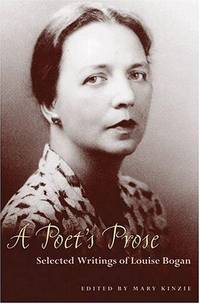
image of Poets Prose: Selected Writings Of Louise BoganThis is as an acute damnation as I’ve read, wickedly sharp, delivered in a masterfully sure stroke; there is an anger here that has sharpened her swing, The spare, cleanly delivered lines and uncluttered imagery reflect an irritation that has been mulled over and considered, pros and cons measured, the complaint reduced to a neatly consolidated statement to which response is difficult. Women have no fields in them, no inner sense of the world outside them, nor a curiosity of the lives that are outside their sphere of self-reference and gratification. They are, rather, provident, little else but skeletal abstractions of consciousness unto which the ideas of others, by implication the doings of men of industry, political where with all and sexual domination, are grafted upon, seeded upon, constantly turned over as the musings and distractions of Masters change at the slightest whim. Bogan’s judgment is severe and short-sighted as to the extent women allow men to define, contain and direct their lives, but this is an account of someone who, though perhaps too close to the contentiously emotional heart of the issue has, ironically, learned her lesson from Master Hemingway, delivering with relish a superbly honed rhetoric that condemns a self-induced stultification of her gender. Rather than take the plow and make use of the field for their own desires and pursuits, she finds her sisters

“They wait, when they should turn to journeys,
They stiffen, when they should bend.
They use against themselves that benevolence
To which no man is friend.
They cannot think of so many crops to a field
Or of clean wood cleft by an axe.
Their love is an eager meaningless…”

They wait for the muse not to come them, like their own idea, hunch or inspiration, but instead to be given to them, like school uniforms and a script to follow. They are consumed with fear, the fear of a loss of security and someone else’s idea of their worth, creating a collective anxiety that converts the collective anger about the oppression into self – hatred, self-debasement. The poet sees this clearly and what Bogan does is present images that imply nothing else but a serial sacrifice of personal ambition, desire, and potential. The inner life of women, this poem, is barren, there is no wilderness to conquer and define in one’s own image, women exist merely as an adjunct quirk of the collective male psychology, a means to gratify an odious male end. Bogan’s poem, years after the heat and convulsions of the blended Civil Rights movements–blacks, women, gays–has subsided and whose goals and values have lodged, to a degree at least, in the mainstream of the culture, this poem remains a potent polemic. It is political without didactic-ism, it is philosophical without abstraction. It has a direct language that finds profundity in the absence of profound sounding words. It is a poem of a near-perfect craft. This is not craft at the sacrifice of emotional power, though; the ire has the sting of a bad memory as the narrator announces her grievances about the seductive fallacy of women making themselves lesser than men.I was just entertaining the idea of adding more to my post here, emphasizing that what Bogan has done is create craftsmanship without sacrificing the heart of the matter, her heart, her feelings. I find the poem wholly convincing as felt experience; the resentment is palpable.

 So many poems, particularly those of the New Formalists, are flawless in their structure and technique but lacking in emotional resonance or even give any idea that the poet knew what it was he or she wanted to talk about. The points in that kind of poetic origami are minor at best, outlines of an experience otherwise sacrificed on the altar of technique. Bogan does not vanish from the poem, her voice is there–I would that her speech in the poem, her cadence, is that of someone who, while angry, wants to make a declaration that is clear, articulate, and understood, in a spare language that is accurate. It is a fire that continues to burn and still ignites passion, debates, discomfort in the reader, from then to the current day. Her accomplishment is that her craft turned into her irritation into an accurate diagnosis that has not lost its relevance. That is not an easy thing to get across.

Monday, June 15, 2020

BORN INTO THIS: a documentary on Charles Bukowski

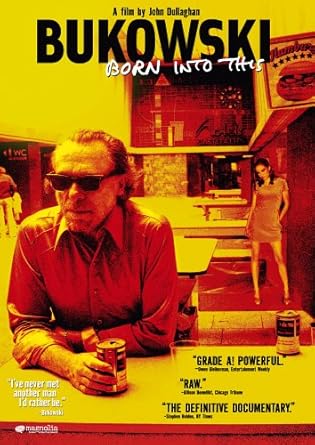
Amazon.com: Bukowski - Born Into This: Charles Bukowski, Bono ...Bukowski: Born Into This on DVD, a documentary on the writer by John Dullaghan demonstrate why fans should be leery of meeting a writing hero, especially if said writer specializes in writing about boozing, whoring, bad jobs, pain, despair, bad luck and bad faith: fairly soon the charm of the man falls away during the classic interviews collected here, and we're given a grim picture of an irritating and maddening personality who could do one thing well, which was to write about his life long fuck ups and regrets. Bukowski's writing was limited and his books are something a reader wanders from after an infatuation of the one-trick genius,but the film leaves you with the feeling that way he wrote about the world he knew was singular and will survive many coming trends and fads in writing life.I'd never say that Bukowski was without art or the transcedent grace of the true poet.Lew Welch said you don't write unless you can't do anything else, and in that sense I suppose suppose the one thing the man could do was understand his pain to it's sharpest , needle point jab and then to tell the truth of it all in a voice that was undercoated and splintered. There is beauty in his verse, but his scope was so narrow that I fear over the years he began to write poems and tales according to what he knew were audience expectations. It's an over cited quote from Frederich Engles, but it bares repeating here; quantity diminishes quality. The poems , I think, were a bit too easy for him to compose on the fly, and this is why I think Bukowski's lasting contribution to American letters is his fiction, especially Post Office, Ham on Rye and Hollywood. Fiction is harder to write, and the world of Henry Chinasky, as Buk imagined it, avoids the easy outs the later poems are won't to have.

For hard core fans only , perhaps, but worth catching or getting on DVD. There was something as touching as revealing about the scene where the monster inside him bubbles up while he's sparring with his wife.It's doubly moving when you recognize Buk's flair ups of rage and aggression from your own experience, if you happen have a back ground involving more-or-less alcohol consumption; it's the urge to destroy everything that's important in one's life, to drive off anyone that cares about you because under all the bravado and gallows humor lurks profound self-loathing that will manifest itself at exactly the wrong moment. Not that there's anyone good moment for booze-fueled flare ups to occur. Writing seemed the one thing that was unconditional in his life, and it is the one thing that kept him either blowing his head off or killing someone else. The rare , black and white footage in the movie was amazing, and it was appropriate to open the film with Buk at the Poet's Theater in San Francisco, puking his guts out before going on stage to read to a packed auditorium. The footage I thought was effective was Buk driving his VW bug, taking his interviewer of the mean streets he roamed. Favorite moment: Buk is going off one anecdote/philosophical tangent when a siren drowns him out. Buk falls silent, the camera captures an ambulence speeding past them, cutting through the traffic to some life and death situation, and then Buk resumes his story as the siren fades, not missing a beat. A perfect counterpoint. I thought Barfly was a blown opportunity, mostly due to Micky Rourke's cryptic stylization of the Bukowskiesque protagonist, who seemed to stuck somewhere between an SNL-quality impersonation of Brando's Godfather performance and DeNiro's habitual screw up in Mean Streets. Faye Dunnaway was a revelation, though, giving a performance that didn't need to be propped up by some by-gone idea of glamour. She did well with the film's tone of washed out naturalism.

One thing that I'm grateful to Buk for is his convincing Black Sparrow publisher John Martin to reprint the novels and stories of John Fante. Fante seems to be the biggest influence on him as a writer, and after reading several of his books-- Ask the Dust, 1933 Was a Bad Year, Brotherhood of the Grape, Wait Until Spring Bandini-- I'm firm in my opinion that Fante is the better writer. A better prose style, a funnier sense of humor, a hardboiled lyricism that rivals the best flights of Chandler. The republication of his body of work, I think, was a significant restoration to the American canon. Fante was a writer of the Last Stand , 
of flawed yet ambitious men advancing toward vainglorious dreams despite repeated wounds to their romantic, out sized egos. What gives Fante his edge is his refusal to soften the blows as he writes about the vanities and fuck ups of instinct driven men;the hurt is palpable, the humor is deadly, the situations believably human.

STEELHEAD by Dave Lucas


Steelhead", a poem by Dave Lucas, is a not-bad addition to the mass of fishing literature that we've read over the decades, a splendidly compact version of Old Man and the Sea or the fishing stories of Jim Harrison (to name but a few). A lone man in the morning fishing the cold lake waters engaged in an activity that's both meditative and primal, and then snap! the line goes taut and there is a magnificent animal at the end of the strand, reeling against the deep gash of the hook, battling to survive with instincts that are beyond the fisherman's ability to adequately turn into a phrase. But phrase it he does, and what we have after the struggle, the splashing, and the final landing of the fish is the inevitable regret not he part of the fisherman, who speculates rather mystically about the cycles of life and death and what it was in him that brought him, against all cultivation and sophistication, to participate in hunter/gatherer behaviors one would have thought had been refined out of him.

If we could see the eyes
or the blunt spade
of its head, we might claim
to see courage in them,
or spirit.


It is this turn where poet Lucas drives off the cliff with a rather labored Laurentian valorization of the Steelhead's spirit and spirit. Lacking tea leaves or a human palm to inspect, he sounds as if he's peering deep into the soon to gutted gills for The Lesson that The Poet is supposed to have. It comes off as some as someone looking for their misplaced cell phone as it rings and keeps on ringing
somewhere nearby. Lucas does not leave it there, though, and continues to sift through the thrashing animal for footnotes and emendations to his discovery of the fish's courage


But what propels its
ten slick pounds
through the water is beyond
what we know of ourselves,
beyond

the education of the angler,
who lets out the line, then
pulls back, the give and take
of two odd lovers, until
the moment

when he jerks back,
when the water gives up
its silver cache.
And then the hollow drum
of fish

on boat. Now we can see
the black eyes, the snub-
nose and gunmetal scale,
the prehistoric fins
that keep on

treading phantom water.
The gills gape. It flips
itself over once, and stares
back with what must be called
defiance.


It would have been fine if Lucas had pondered the sadness, if sadness is the word, in terms less lofty, but he ruins, utterly ruins his effect by the ham-handed and equivocating insertion of "...and stares back with what must be called defiance."
Well, no. We shall call it a dead fish and admit that fish eyes are expressionless, in fact, they exhibit no nuance of emotion, and that the term "fish eye" is synonymous with a stare that is seemingly without life, emotion, or empathy.

I can see why this would strike readers as a powerful poem, but it reads to me more an exercise on a subject that's hardly unrepresented in literature. Lucas is a good writer and I rather liked the leanness of his descriptions, but what I couldn't escape was the expectation that there would come, toward the end, something Lucas learned from
hooking this particular fish. It's obvious, and it seems false in execution. One would imagine people this given to revealed truths from common events would be too sensitive to fish in the first place.

This might have worked better had Lucas given us a proper parallel set of events. Imagine this poem's narrative commencing without the attempted anthropomorphizing, just told straight faced, and then we have the fisherman involved in his own struggle that he would struggle with, seemingly in vain, such as trying to get out of snowed in parking lot, or being at the end of a very long line for gas. Just a suggestion, but the point is that the comparison between the fish he hooked and human qualities would be more plausible, less strained.
The steelhead is imbued with human characteristics such as "spirit", "courage" and "defiance", which indicates that the narrator his comparing his lot against that of the creature hooked on the line. It's not far fetched to assume that the narrator assumes the fish to be in a state of shock, to be at the end of a line, on a hook, unable to breath, and that the empathy extends further to the irony of his own situation; a sophisticated person indulging in primal activities where raw survival is the only matter at hand. In any regard, I think the implicit message is more of a package one deals with when they decide to write this kind of poem, which is to say that it's less Lucas doing the talking/musing than it is a fulfillment of genre expectation.

Which makes it frustrating because this poem almost works. A bit of indirection instead of a direct address of his idea might have given us a surprise instead of disappointed groan. Lucas's narrator is looking for a human quality when
the regret of winning the battle hits him. What it comes down to was that what he might have seen--Lucas is smart to hedge on his qualifications-- , whether courage, spirit, defiance, are intended as a Lesson. Lucas wants the lesson to be a military one; given the choice of qualities he tentatively assigned the Steelhead. All this is certainly implied, and it's worth bringing out.


I tried thinking of the poem as a lean metaphor for invasion and defense of territories and to think of it as a critique, somewhat, of the current failure of American foreign policy, but that it became a labor-intensive riff as I worked on it. Sure, the elements are there in order to make the case, but I still think Lucas is wandering through Rousseau's neck of the woods and imagines himself in battle with an ennobled animal. Lucas is a good writer, but I'm not enamored of the mythology he wants to handle with a straight face here, unless, of course, he were willing to step several miles further than the conventional  struggle/victory/winner's remorse scenario these pastoral situations must have and instead do something truly remarkable. There's a Paul Auster novel I can't remember the title to in which the point of view is the dog's who, credibly, is burdened with the task of finding a new master when it realizes his current one is dying. A remarkable read for a straight-forward novel.

BLANK VILLIANELLE by Ron Spalletta


Reflective grief forces language to cut the losses incurred by smoldering metaphors that oftentimes confuse instead of clarify the ache of loss. It seems to be the case that in time of pouring over the memories and mementos of who was here and what they said and what they left behind after their passing creates an ache that is sometimes described as a wind whistling through a hole in your gut. In my case, it is the feeling of quite suddenly feeling that the floor beneath me had given way and that the only thing that was certain was the abyss that awaited me, something I would imagine feeling should I ever be in an elevator when the cable snapped. It is , in essence, the sharp fact that something has been removed from your life that cannot be replaced.  Ron Spalletta's poem, Blank Villianelle,  seems a perfect expression from someone attempting to put into words the combination of emotion and texture that is the grain of recollection; what comes to the tongue is the filtered essence of details that might otherwise overwhelm you . It has an articulate bluntness that desires not to be mistaken for anything other than a representation of the dull, sad ache of sadness.

Blank Villianelle
for Patricia

As long as you want
almost never is
as long as you want,

or it is much longer.
He will not live
as long as you want,

but his forgetfulness
will last as long as memory,
as long as you. Want,

at once desire and privation,
is the work of his disease.
As long as you want
him, you return to watch hours
unravel. Are they hard as yours,
as long? As you want

to let go of the ghost,
you say "but I'll stay
as long as you want,
as long as you want."

People don't live forever in our memories because those with the memories don't live forever, a knowledge that is at the core of all our grieving  and drives us to move on, to the next stage in our own journeys. Promises made, kept, betrayed, a set of agreements, pacts, shared secrets upset by intervening mortality; this is the moment one would realize that one chooses to live in the present tense because there is no other way to negotiate that hard corners of a life intended to achieve and grow, and that the regret of how we've conducted ourselves up to the fateful moment is an irony that seems inevitable. It seems a condition of living with the capacity to use language as the buffer against the panic a random universe creates. But as authors of our own fate, we realize, finally, slowly, that the story ends only when the author drops the pen . The story, of course, will be picked up by someone else who will mistake the particulars as their own,  therefor original.

Saturday, June 13, 2020

Adam Zagajewski

 This is one of the many crank rant poems I used to enjoy writing when the combination of coffee and cigarettes had sufficiently charged me and reinforced what my ego demanded a clean and sober artist must be in order to be interesting, expressive, a hat full  of cornball gestures: the personality I'm trying to project here is, please note, fictional and the intimations of wild things having happened with serio-comic consequences are created from whole cloth as well. This might blow my reputation as a poet who recounts hard living in funny and bittersweet couplets and rhythmically charged lines that simulate the rapid eddies of a Freddie Hubbard solo. Well, it might threaten what street cred if I had a reputation more expansive than friends, estranged drinking buddies, a few associate professors and members of my family who like what I do no matter what it is I put on the dinner table. I make stuff  up in half the stuff you'll find in my various chap books, anthologies I've been included in, the various blogs I fill with words that yammer and shriek a loud, if vaguely articulated discontent. 

Discontent with the skin I'm wearing, more than likely, as this current sheath is wrinkled, getting flabby and the joints ache worse than the linger effect of losing whatever person, place or thing that truly mattered to your existence. But don't think this a dishonest poem; I disagree with the notion that poetry in this age requires the poet to expose their darkest don't-tells. Poetry will not change behavior and will not make you feel better about being a shit heel; that is what therapists are for. 

This , I think, is worth reading for the same reason some recent science fiction movies are worth seeing because the computer generated animation sequences are  as spectacular as the stories that justify their use are insipid. This is honest poem because the attitude, the language, the tone that waivers between confirmed don't-give-a-goddamn and the  congealed frustration that threatens to become something louder ,  vulgar and violent. They ring true for me and reflect those days a time ago where going insane seemed a viable an option as any young alcoholic artist and poet could choose. Thankfully, I have survived the logic of the heated impulse and stayed around long enough to enjoy a more modest means of getting to the point. --tb

_____


 The rocket's red glare

how drunk could be get
before we began to
look attractive to the
flies that buzz around
our heads ,

against
the broad strokes
of red
and henna coded clouds
that set the horizon on fire
as the sun sinks
just a tip under the
blurred line of the planet
where earth and sky
are a duo
that play one masterful rondo
after another
one of us stands up
to God and his
whispering minions
that he is tired of
suffering the results
of a good idea
gone to bullet bursts
and fist fights over the change left
on cafe tables.


i raise my head from my palms,
stop studying the way
my shoe laces are
coming untied,
i gather a sense that
there is more to life
than gas , food and lodging
but would settle
for any thing
because i had
none of the above
and no love for curbs
and the drainage dreams
they inspire,
i ask
"IS THERE AN ARE ART SHOW
CLOSING SOMEWHERE TONIGHT??"

the other one of us
was still
drinking as he careened up the street,
one side to the other,
all the billboards
should read "tilt",

"LOVE STRAYS
AND STAYS ARID"
he yells at a passing bus,
i laugh, Jesus what a jerk,
i will take the bus
and play music in my skull
until it comes,
i will be serene and lean
on the vernacular
that's so spectacular
when I'm in the bag
and full of mean remarks,

i will behave,
i will be silent,
nothing will upset me,
i am invisible on the bus line,


but even as my mantra
is uttered and folded
into a vest pocket of the soul
over where the heart still beats
with what remains of
my sense of my self and
virtues beyond the
bulge of my wallet,
a car approaches
through the intersection,
it veers closer,

i sing to the streetlights,
the fixtures on the power lines,

the car slows down,

i'm on the twelfth chorus of "Cherokee",

something breaks in my lap
and then I am wet
with water
neither painful nor holy,

the car speeds away
into the slim v perspective
that runs right to the water's edge,

i am wet
yet am i blessed
in such a state,
i hum another chorus,
my lap drenched
with tap water and
bits of burst balloon,

and now it's dark
after eight pm in July
when the fireworks go off
from the end of the pier,

where i wanted to be
to make a phone call
under the rocket's red glare.
_____


At face value, the poem "About My Mother" By Adam Zagajewski appealed to me;I like the idea of the rushing stream of words, breathless and minimally punctuated in their rush to the the last crystallizing image; when it's done well, when the subject catches a little considered incident of experience and riffs on it briskly, quickly, ending, finally, on a surprising note in the run, that nuance you didn't know existed between the words you'd use to objectively outline your emotion, the effect is exhilarating.
When it works , that is.The secret , I think, is creating the feeling that you, the writer, was just as surprised by the ending as you hope the reader will be. When it doesn't work, the effect is a desperate assembling of random clauses, unconsidered, a piling on of things that happen to be in the room of memory one is rummaging through for something to write about. "About My Mother" reads as just that sort of poem, something composed in order to have written something, a short form limning of a problematic relationship with one's mother. The narrator recalls things said, meals made, silent gestures in response to his presence in the same room , presented in a tone that does not quite mute an otherwise undercurrent of anger and regret; you know where this is going, you know the destination this poem has in mind for you--


when she
compared herself to Beethoven going deaf,
and I said, cruelly, but you know he
had talent, and how she forgave everything
and how I remember that, and how I flew from Houston
to her funeral and couldn't say anything
and still can't.


This is meant to take our breath away , to elicit a surprised gasp, to make us feel someone had just walked over the spot we will eventually be buried, but it comes as no surprise. It's unreasonable to think this poem as calculated; the last image was conceived first and everything else was composed afterward, the delivery system for the punch line. The details that come before are a conspicuous set up for this melodramatic ending; the reader who has done the due diligence and read and studied the confessional tendencies of Robert Lowell or Sylvia Plath might find this template familiar, like a route to work they take five days a week on public transportation. The poet's mute regret at the funeral is merely the last stop through a scenario that scarcely deserves remarking upon.

Friday, June 12, 2020

VACHEL LINDSAY DOOR TO DOOR

like the idea of Vachel Lindsay rather than the practice of  reading his work, or even listening to it, the often made apology of some of his defenders who maintain that his works are meant to be performed, not scanned in anthologies. As Lindsay was entranced by song and its subversive adeptness of slipping past a censoring intellect and infest and infect the soul with all manner of radical and subtle emotional stirrings, his work was meant to be exclaimed and dramatized for their power to be fully felt and fairly surmised. Fair enough, I say, but too often what I find in his work is the cadence of a creaky gate swaying in a steady wind, or a swing rattling on its chain. He seeks to grasp the moment of when he discovers the unchanging difference between right and wrong; he wants to create an emotional response in the reader that will not tolerate injustice nor stand for suffering; he wants the poetry of the period to influence the listener to cease with their odious doses of bad faith and to instead live genuinely, fully, not taking a breath nor another life for granted. All this is well and good, but to me it is hokey. His task was to  grant everyday things and ordinary lives a dignity they hadn't been given before, but in doing so he manages to add yet another thick layer of metaphorical tonnage that keeps us further from the metaphysical presence he is longing for.

 I have a difficult time even considering his writings the evidence of a fevered imagination setting up and alternative universe, of a sort, in his quest to unearth and reveal the true nature of the everyday. The Congo, I think, is racist bombast, pure and simple, an example of a well-intentioned progressive in spirit trying to pay homage the culture of a people whom whites kidnapped and subjugated with slavery; he comes off as condescending and half baked. I think he only added to the problem he wanted to remedy. There is a difference between VL attempting to write something he called a history of the negro race and Duke Ellington, a black composer and intellectual, taking ownership of his own ancestry , traditions and , most importantly, the stereotypes of his race and culture and creating some astounding art. Good though his intentions were, VL's poem is paternal , presumptuous and racist by attitude and application; there is the fundamental assumption that Africans and those of African descent were incapable of telling their own story. Ellington, along with a good amount of the work of Langston Hughes coming out the Harlem   Renaissance redefined the terms. VL's attitude is simply hard to sit through without a session of exaggerated defenses and hearty condemnations. Spirited debate is fine, of course, but it seems to me that Ellington's "jungle music" is the superior work of art becomes the genius, verve and timelessness of the composer and his singular orchestra's work puts one in the center of the music, not a field of footnotes and gutter sniping. The seeming irony of a black artist using the world "jungle" to describe his own music seems irrelevant at best.

I understand the interest Allen Ginsberg had in Lindsay, since VL would, at the time, be the closest America had to a William Blake. Blake, however, gave into his visions to the extreme and allowed them to cohabit with him in his daily life; there incredible things he maintained in his public life about his visions and his dialogues with angels that he spoke of  as a matter -of -fact.

The further evidence is Blake's work which is truly unique, ungainly in syntax, but completely unforgettable as to how the universe was structured, at the core, rubbing against the flesh of the god or gods that created the heavens and the earth. Blake zipped past the clichés and ready-made paradigms that available to him and created something from whole cloth. His work broadened and became denser as he grew older; he wasn't much interested in getting others to change their behavior so much as he was in creating a vivid sense of what it is everyone man, woman and child will have to face. He considered himself a poet of the Inevitable. Lindsay, of course. An intriguing intersection of influence and cross influence; you can see how Bob Dylan and Phil Ochs were attracted to Lindsay not just as a public poet , but a public visionary, someone who could capture the public's imagination with broad , sweeping movements of image and colorful narrative. Lindsay did, of course, argue through his career a series of conclusions informed by a firm sense of what was right and wrong in society and wrote in such a flamboyant fashion that he might seduce, persuade, cajole those attracted by his theatricality to change the limited way they came to regard the world. He desired to instill in his listeners (and readers) the notion that everyone has a humanity that cannot be reduced by economic oppression or removed by harsh laws. It was the idea, a powerful one, that the morally upright thing to fight for--fairness, justice, equality, democratic virtues--were self-apparent, or would become so once the best case was made with the most persuasive language only one who is touched by the muse can write and recite, compose and exclaim.

 Dylan and Ochs perhaps had an easier time, being songwriters connected with a host of progressive causes--civil rights, anti-war movements largest among them--and it was their skill at composing brooding, simple, compelling melodies to hammer away at their inspired rhetoric that kept their songs, their lyrics in the public mind. Much of the oft repeated support of his work, even at its most anemic ,is the puffery one suspects zealots contrive in a mission to raise the importance of a hero they've embedded deeply into the soft tissue of their consciousness. This is something that we find with writing about Dylan--so many elaborations and comparisons that the apologies are more nuanced than Dylan's actual work. All the same, there is a strong connection, an awareness, a deliberate alignment on Dylan's part with a tradition other than rock and roll. The claims that Dylan was influenced by Lindsay, the Beats, Whitman, or "the usual Modernist suspects" are far from fantasy. The influences are traceable, noticeable, conspicuous in a great many songs, like "Desolation Row", "Visions of Johanna", "Memphis Blues Again", "Gates of Eden"; surreal though rock and roll geniuses Little Richard, Chuck Berry and Bo Diddley may seem and have been in their work and personas, the aforementioned songs definitely came from exposure to a good number of modern poets, ranging from the Symbolists through Whitman, Eliot, Burroughs, Kerouac, Ginsberg. 

Those influences are in Dylan's work; how much he absorbed of what he read is the wrong question, but rather how well. Dylan, as any good artist would, took what he liked and what he found useful in musical styles and literary modes and made them his own. Dylan’s accomplishment, his singular bit of real genius, was blending Chuck Berry with his personal version of street level surrealism. Nothing like it existed in lyric writing before it--and I am not insisting that Dylan is the one who made song lyrics poetry, a notion I've railed against for years--and to diminish or dismiss literary influences in the creation of this body of work is, I think, short sighted. This is the kind of ruthlessness of the creative process no one really likes to talk about--it is the cliché of the amateur borrowing as opposed to the professional, who steals, who literally talks ownership of what he came across. VL is part of the circle of influences, more for inspiring a public persona and purpose than for direct influence on the work. Like it or not, VL did set the groundwork for what a public artist with literary/musical inclinations would be, and Dylan is among the generation of songwriters who adopted JL's conceit for their own purposes.
Along with Ginsberg, who desired to become a the voice of a perceptions that found expression before a conservative superego diluted whatever power might have been had in the first thought, songwriters who had grown up with Lindsay's work were inspired to write about things that were meant to resound beyond the music hall, wrote for his audience, which is valid on the face of it, but his temperament is closer to that of a songwriter than a poet on the grandest scale. It was, for Lindsay about what would sell, in a manner of speaking; his is also a cautionary tale against pleasing an audience too well, as there is the threat that will not let you change. And that is the frustration that kills a talent that has the potential to evolve.

Tuesday, June 9, 2020

SONG BY FRANK O'HARA

Frank O'Hara is a significant poet for many reasons that can be and are in fact argued when poetry lovers of different loyalties get together to dispute reality and slice up their share of the muse's lavishly set the table. What that last sentence means precisely, especially the last flourish, is unknown even to me, and this is not the place to speculate or suggest subtext or subversion. Frank O'Hara is a favorite of mine because he is, after all, A MAJOR POET   who wrote masterfully about the momentary thrills and anxieties of being a nervous, fretful, art-loving man in love with the city who, likewise, could make his discomfort unavoidable urban annoyances--traffic jams, bad waiters, boring posers--into occasions to elevate himself with the joys he knows he, in fact, possesses, As in the song, a moan is turned into music, the idea of being stuck and uncertain turns into succinct, near haiku meditations on eroticism, companionship, the nearness of another. 


SONG

I am stuck in traffic in a taxicab
which is typical

and not just of modern life

mud clambers up the trellis of my nerves

must lovers of Eros end up with Venus

muss es sein? es muss nicht sein, I tell you

how I hate disease, it's like worrying

that comes true

and it simply must not be able to happen

in a world where you are possible

my love

nothing can go wrong for us, tell me


 O'Hara did this constantly--hundreds of short lyrics, or half lyrics, as it were, Sapphoesque scraps. The flush of dread over the nervous system becomes the rush of anticipated delight in friends, talk, drink, love. This, we may judge, is not the best O'Hara could do as a writer,  but that is precisely the point for its composition; much can be made too much of an artist's process as it relates to a larger body of work and the community it resides, but the charm here, the beauty itself, is what I'd call an excellent attempt to express a sensation that defies anyone's ability to capture. O'Hara's poem, simply called "Song" with no other words of grandiose teasing, falls short as well,  ultimately. But it is a terrific near miss, successful enough to get one thinking about why one keeps reading again after thirty years since one first sat down with the Collected Poems of this modern master.